Shell art is practiced everywhere salt water meets a shoreline, but Southwest Florida - specifically the arc of Gulf Coast from Estero Bay north to Sanibel Island - is where the medium carries real cultural weight. The region produced the longest-running shell show in the United States, the only national shell museum, a named technique with a living community of practitioners, and a tradition that connects unbroken to two thousand years of Calusa craftsmanship. This guide follows that record from the shell middens of Mound Key to the juried walls of the annual Sanibel Shell Show, with enough practical detail to serve both the collector and the artist.
Why Southwest Florida Is Ground Zero for Shell Art
The raw material question comes first. Shell art needs shells, and no stretch of the United States Gulf Coast produces them in the variety and quantity that Sanibel Island does.
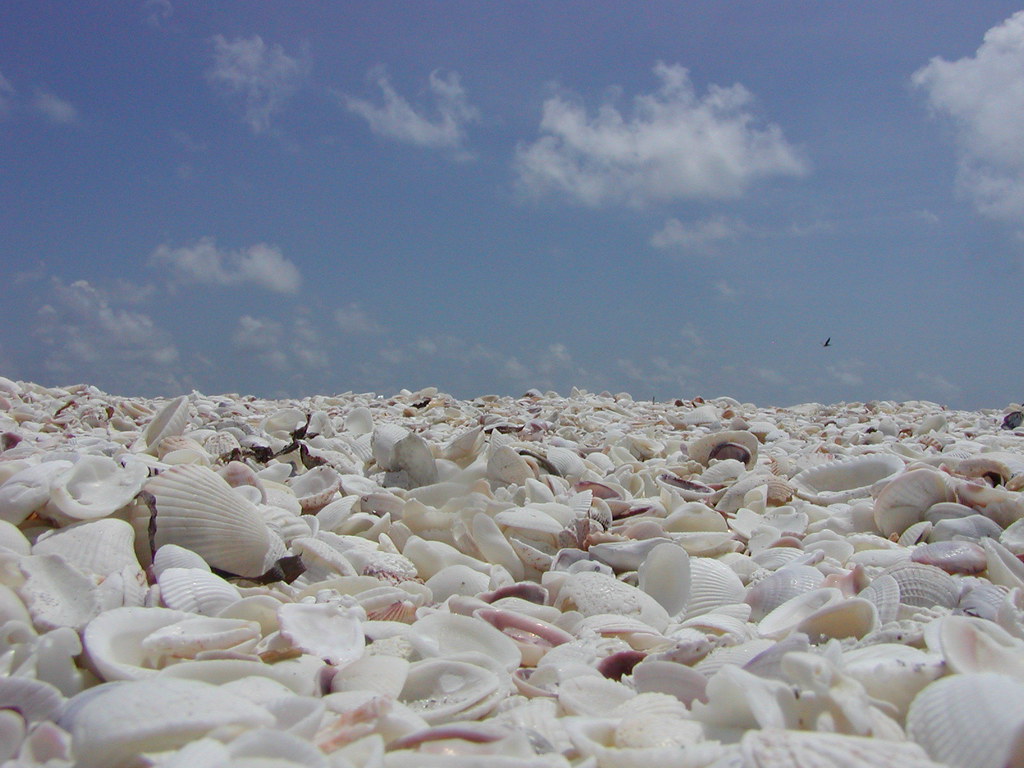
Sanibel runs east to west rather than the north-south orientation of most Florida barrier islands. That single geographic fact changes everything. Prevailing winds push Gulf and Caribbean currents toward the island's south-facing shore, and the gradual slope of the offshore continental shelf slows those currents just enough to drop their cargo. The result is a beach that collects shells from a range far larger than its local waters - depositing them in drifts dense enough to give the act of collecting its own regional nickname, the Sanibel stoop.
What comes ashore here - lightning whelks, junonia, lion's paw scallops, true tulips, horse conchs - gives artists a palette unavailable on most coasts. The color range, the structural variety, and the sheer scale of some specimens shifts the possibilities of the medium in fundamental ways. Shell art made in Southwest Florida is made with the best local material in the country.
Beyond geography, the culture has accumulated for generations. The Sanibel-Captiva Shell Club, founded in 1961 with 27 charter members, now counts more than 500 members. It organizes not just the annual juried show but a weekly crafters group that has met continuously for decades. That institutional density - a museum, a competing club, a juried show, working artists, gallery representation - is what distinguishes this region from places that simply have good beaches. It is a place where shell art has had the conditions to develop as a serious medium.
The Calusa Foundation: Two Millennia Before the Shell Show
Southwest Florida's shell-art history begins long before any hotel porch display. The Calusa people occupied the region for approximately two thousand years before European contact, and shells were central to their material culture in ways that go far beyond collecting.
The most visible evidence is Mound Key, an approximately 125-acre island in Estero Bay in Lee County. The island is composed almost entirely of accumulated shell and soil deposits - the cumulative refuse and construction material of a civilization - rising to more than 30 feet at its highest point. It served as the ceremonial capital of the Calusa and is now Mound Key Archaeological State Park. Standing on it, shell becomes legible not as an art material but as a foundation: for buildings, for elevation above floodwater, for the physical expression of political power.
Calusa artisans used shell tools to carve elaborate wooden ceremonial masks and objects. The precision required for fine woodcarving using shell implements represents a high level of craft skill, and the objects produced were the visual and religious art of a sophisticated society. The Calusa sustained themselves not through agriculture but through tribute from surrounding villages, freeing artisans from subsistence labor and creating conditions for specialized craft production.
Their pigment technology shows the same sophistication. Artisans mixed cochineal dye with latex from strangler figs to produce a red pigment used on ceremonial objects. That is a composite process requiring working knowledge of multiple natural systems. It was not improvised.
The break between Calusa practice and the present shell-art community is real - European disease and conflict ended the Calusa as a living culture in the eighteenth century. But the material continuity is worth acknowledging. The shells on Sanibel's beaches today are the same species the Calusa worked with for two thousand years. When a contemporary artist picks up a lightning whelk on Sanibel and decides what to make with it, they are standing on a foundation of practice that is very old.
The Sanibel Shell Show: From Hotel Porch to National Institution
The modern competitive tradition has a specific origin point. In 1928, the owner of the Matthews Hotel - later to become the Island Inn - invited guests to lay their collected shells on the front porch for informal display. It was a social occasion, not a competition, and it matched the leisurely pace of an early twentieth-century beach resort.
The event formalized over the following decade. By 1937 it had been reorganized and officially named the Sanibel Shell Show. That first named year drew more than 1,000 visitors - a significant number for an island that had no bridge to the mainland until 1963. Word spread through the shell-collecting community, which even then had dedicated journals, clubs, and correspondence networks that crossed national boundaries.
The show, held the first full weekend of March, is now the longest-running shell show in the United States. The venue has shifted over the years - after Hurricane Ian it moved off-island to the Marriott Sanibel Harbour Resort and Spa in Fort Myers for several recovery years before returning to the Sanibel Community House in 2026 - so verify the current location with the Sanibel-Captiva Shell Club before attending. It draws competitors from Japan, New Zealand, Europe, Canada, the Virgin Islands, and across the country. More than 200 exhibits appear in a single showing. It is considered the most prestigious competitive shell show in North America.
How the Show Is Judged
The juried structure matters for anyone trying to understand what the show reveals about the state of the medium. Entries divide into two broad divisions - scientific and artistic - and the artistic division is where shell art is evaluated as fine art. Artistic categories include:
- Jewelry (wearable work incorporating shells)
- Sailor's valentines (the octagonal mosaic box form)
- Shell mosaics (flat or dimensional pictorial compositions)
- Shadow boxes (three-dimensional arrangements in framed box constructions)
- Shell sculptures (freestanding or relief work)
- Mounted arrangements (formal display compositions)
Separate competition tracks run for professionals and hobbyists, so the judging does not pit a full-time working artist against a skilled amateur. Awards include trophies, ribbons, and a People's Choice Award voted by visitors - which often diverges from the juried results and reflects what the general public finds most compelling in the medium.
Shell Art Techniques: What the Work Actually Involves
The artistic categories at the Shell Show map to genuine technical traditions. Understanding what each technique requires changes how the work reads.
| Technique | Primary skills required | Time investment | Gallery market presence |
|---|---|---|---|
| Sailor's valentine | Mosaic geometry, tiny-shell selection, color theory | Very high - weeks per piece | Strong, fine-art galleries |
| Shell mosaic | Composition, adhesion, fill technique | High - days to weeks | Moderate, gallery and commission |
| Shell jewelry | Lapidary basics, wire work, drilling | Moderate - hours to days | Strong, jewelry and gift markets |
| Shadow box arrangement | Spatial composition, archival mounting | Moderate | Moderate, interior decoration |
| Sculptural installation | Structural engineering, mixed media | Very high - project scale | Commission-based, commercial and residential |
Sailor's Valentines
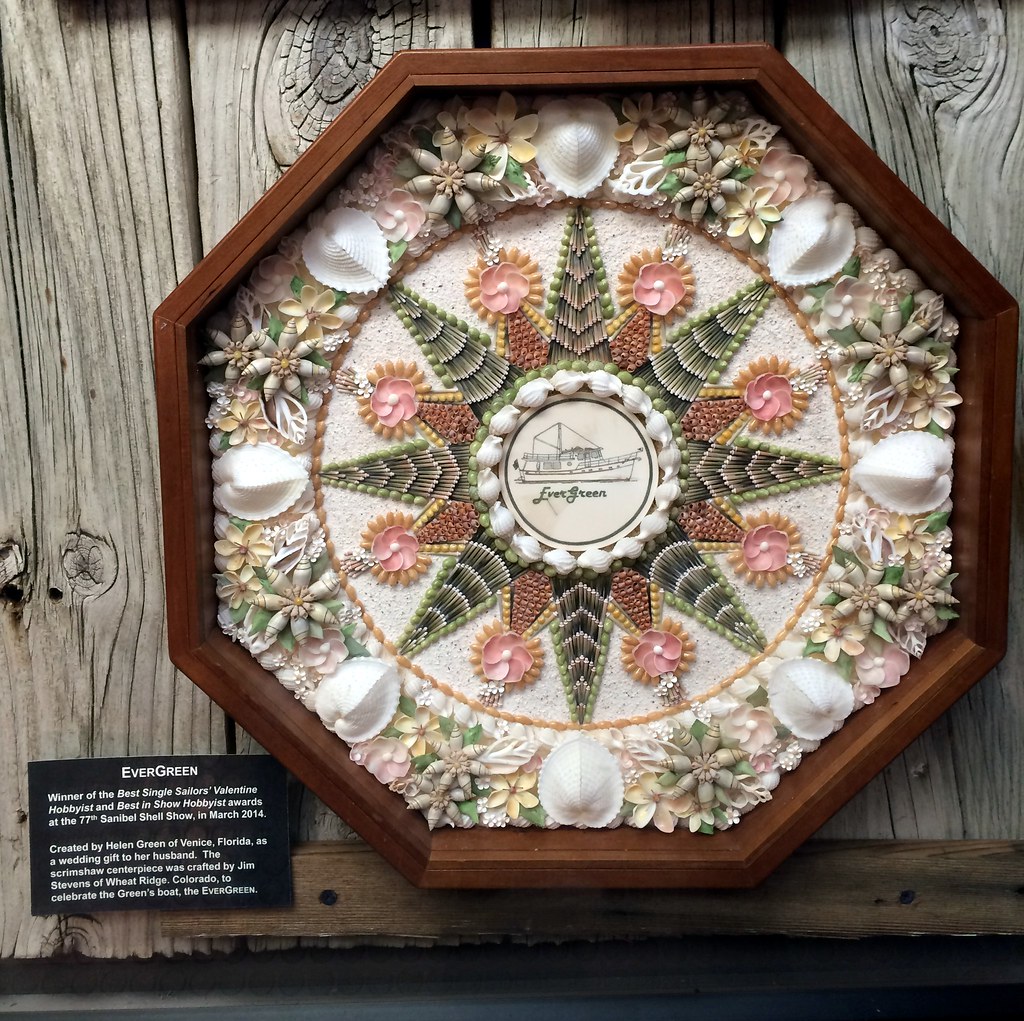
Sailor's valentines deserve longer treatment because they are the technique most closely associated with Sanibel and the most demanding to execute well. The form is an intricate mosaic of tiny shells - sometimes hundreds or thousands of individual specimens - arranged in geometric or floral patterns inside an octagonal hinged wooden box, typically with two panels that fold together. The boxes originated in Barbados, where craftspeople made them and sold them to sailors as souvenirs; despite the name, the connection to sailors personally crafting or carrying them home as handmade gifts is largely mythological.
What makes the form technically difficult is the selection and placement of shells at very small scale. The artist must work with specimens measured in millimeters, sort by color, texture, and size, and execute a design - often radially symmetrical - that holds up to close inspection. A single piece can require weeks of work.
Artists Working in the Medium Today
The working artist community in Southwest Florida is larger and more professionally serious than most visitors realize.
Ginny Dickinson is among the most visible. Her shell art is displayed across Sanibel Island and at the Fort Myers Regional Airport - which puts her work in front of a steady stream of arriving visitors who may never have considered shell art as gallery-quality work. Her pieces have been auctioned at charity events, the standard mechanism by which Southwest Florida artists build both recognition and community ties.
Pamela Boynton's sailor's valentines have reached a wider geographic market. A Sanibel resident, her work is shown in fine-art galleries on Cape Cod, Nantucket, and Sanibel - a spread that positions the form alongside the established decorative arts markets of the Northeast rather than limiting it to Florida souvenir territory.
At the commissioned sculpture end of the market, Katarina Tifft works under the trademarked name Shellscapes. Her bespoke shell-art installations are created for residential and commercial interiors and have been commissioned across the United States and internationally. This is the category of shell art that operates closest to the design and architectural market - large-scale, site-specific work priced and scoped like a commission from any serious fine-art medium.
The Shellcrafters subgroup of the Sanibel-Captiva Shell Club represents the broader community of makers. The group meets Mondays at the Sanibel Community House - a consistent, accessible point of entry for anyone who wants to learn from working artists in an informal setting.
The Bailey-Matthews National Shell Museum: Collection, Art History, and the Post-Ian Rebuild
The Bailey-Matthews National Shell Museum opened in 1995 on land donated by the Bailey and Matthews families of Sanibel. It is the only museum in the United States devoted primarily to shells and mollusks, and its collection holds nearly 600,000 specimens. For anyone approaching the region with an art-focused interest, the museum is essential context rather than optional enrichment.
The only museum in the United States devoted primarily to shells and mollusks holds nearly 600,000 specimens and permanent exhibits on shells in art, history, and world trade - making it the single most concentrated resource for understanding the full cultural range of the medium.
The permanent collection includes dedicated exhibit space connecting shells to the Calusa culture, examining shells in art and history across multiple civilizations, and tracing the role of shells in world trade and decoration. These are not side notes. They frame the material that Southwest Florida's contemporary artists are working with as something that has carried meaning and value across human cultures for millennia.
Hurricane Ian and the Phased Rebuilding
Hurricane Ian made landfall as a Category 4 storm in September 2022. Five feet of storm surge pushed through the Bailey-Matthews Museum, destroying the aquarium gallery and severely damaging the Great Hall of Shells - the core of what most visitors come to see.
The rebuild proceeded in phases. The museum reopened in its first phase in March 2024. Phase 1 of the rebuilt Great Hall of Shells opened in May 2025, and Phase 2 completed the post-Ian reconstruction in October 2025. The museum is now fully operational with the rebuilt Great Hall open. Check the museum's official site for current hours and exhibit details before visiting.
Classes and Workshops: Learning Shell Art in Southwest Florida
The region has genuine infrastructure for learning. Finding the right entry point depends on what level of commitment fits the visit.
- Shellcrafters at the Sanibel Community House: The Monday meetings of the Sanibel-Captiva Shell Club's Shellcrafters subgroup are the most consistent local resource. The group is open to new members and covers multiple techniques with guidance from experienced makers who have competed in the juried show.
- Sandy Moran's sailor's valentine workshops: Moran teaches two-day workshops on Sanibel focused specifically on the sailor's valentine form. A two-day commitment is calibrated to let beginners complete a small piece - which is the right goal for a workshop, since finishing something tangible teaches more than observation alone.
- The Shell Show and Shell Festival weekend: The juried show and the separate Sanibel Shell Festival held the same first weekend of March together create the most concentrated period in the year for meeting working artists. Artists at the festival are present to sell and discuss their work, making this the best single opportunity in the region for conversations about technique and process.
- Museum programs: The Bailey-Matthews Museum has historically offered programming tied to its exhibits and collections. Check their current schedule directly - programs change with the museum's evolving exhibit calendar.
Where to Find and Buy Shell Art: Fine Art Versus Souvenirs
The single most useful thing a buyer can know in this market is what distinguishes fine-art shell work from commercially produced shell decoration. The same material - shells on wood, shells in resin, shells in a frame - can be handmade original work by a named artist or factory-produced imports with no connection to Southwest Florida at all. The price difference is large, but so is the value difference for the collector or gift buyer who wants something genuine.
Signs of Fine-Art Shell Work
- The piece is attributed to a named, identifiable artist with a local or regional reputation
- The shells used are identified by species, suggesting material knowledge rather than bulk sourcing
- The work has been exhibited or placed in a juried context - Shell Show ribbons or gallery representation are verifiable
- The construction shows hand-selection and individual placement rather than mass-production regularity
- The artist is accessible for questions, through a festival, a gallery, or a club affiliation
What to Treat with Caution
- Unattributed shell arrangements with no artist information
- Work that uses shells not native to the region presented as if they were local specimens
- Resin-embedded shell work without any identification of source or maker
- Pieces in airport or chain gift shops priced as generic souvenirs - these are rarely made by regional artists
She Sells Sea Shells, a family-owned shop on Sanibel in business since 1976, is the longest-established local resource for both specimen shells and handmade shell art. It has been voted Best Shell Shop in Southwest Florida by Fort Myers News-Press readers every year since 2000. For fine-art work at gallery level, the Shell Festival is the most direct route to meeting makers in person. For commissioned sculptural work, Katarina Tifft's Shellscapes practice is the highest-profile example of what that market looks like in Southwest Florida.
The Bailey-Matthews Museum gift shop has historically carried work by local artists and provides implicit vetting that a general tourist shop does not, since the curatorial context of a museum shapes what it stocks. For the collector building a serious shell-art collection, the juried show results - which are publicly announced each March - are the clearest signal of which makers the regional community itself regards as doing the strongest work.
Frequently Asked Questions
When is the best time to visit Sanibel for shell art events?
The first full weekend of March is the peak moment, when the juried Sanibel Shell Show and the separate Sanibel Shell Festival run concurrently. More working artists are present and accessible that weekend than at any other point in the year. Outside of March, the Shellcrafters group meets every Monday at the Sanibel Community House year-round, which is a quieter but consistently available alternative for anyone who wants to engage with the local maker community.
Is the Bailey-Matthews National Shell Museum fully open after Hurricane Ian?
Yes. Phase 1 of the rebuilt Great Hall of Shells reopened in May 2025, and Phase 2 completed the post-Ian rebuild in October 2025. The museum has been operating since its phased reopening began in March 2024. Check baileymatthews.org directly before visiting for current hours and exhibit details.
What is a sailor's valentine and can I commission one in Southwest Florida?
A sailor's valentine is an intricate shell mosaic set into an octagonal hinged wooden box, with shells arranged in geometric or floral patterns at very small scale - often radially symmetrical designs requiring weeks of work to complete. Pamela Boynton, a Sanibel resident, shows sailor's valentines in fine-art galleries on the island and in gallery markets on Cape Cod and Nantucket. Sandy Moran teaches two-day workshops on Sanibel for those who want to learn the technique rather than commission a finished piece.
How do I know if shell art I am buying was made by a Southwest Florida artist?
Ask for the artist's name and look for a local affiliation - Shell Club membership, Shell Show ribbons, or gallery representation on Sanibel or in Fort Myers. Shell Show entries are credited to named makers, and artists who participate in the annual festival are present in person and can answer directly. Work sold without any attribution to a named person is almost certainly not from a local working artist, regardless of where the shop is located.
What is the connection between the Calusa and today's shell-art community?
The connection is material rather than genealogical - the Calusa as a people were largely destroyed by European contact in the eighteenth century, so there is no direct cultural transmission. What continues is the place and the material: the same shell species that Calusa artisans used as tools and pigment sources are what contemporary shell artists on Sanibel collect and work with today. The Bailey-Matthews Museum's permanent collection makes this connection explicit, with dedicated exhibits on Calusa shell culture alongside exhibits on shells in art history more broadly.
Can I see Calusa shell work in person near Southwest Florida?
Mound Key Archaeological State Park in Estero Bay is the primary Calusa site in the region - the entire island is a constructed shell mound that served as the Calusa ceremonial capital, accessible by kayak or boat. The Bailey-Matthews Museum includes Calusa cultural material in its permanent exhibits. For carved wooden objects made using shell tools, the Florida Museum of Natural History in Gainesville holds significant Calusa collections, since preservation conditions on Southwest Florida sites favor shell over organic materials like wood.