What makes Southwest Florida a good place to start a collection
Supply is deep, the middle market is real, and in most venues you can meet the artist who made the work. Original paintings start well under $500 at co-operative galleries and open studios — a price point unusual in larger markets. The November-through-April season brings the region's strongest gallery programming and back-to-back outdoor festivals, giving a first-time buyer more concentrated choice than most cities of comparable size can offer.
What to expect to pay
At member co-ops and art league shows, small original works start under $100 and most pieces sell for under $1,000. Emerging and local artists at festivals and juried shows typically price originals from a few hundred dollars to several thousand, depending on size and medium. Commercial galleries on Fifth Avenue South in Naples or the River District in Fort Myers start higher — often several thousand dollars for established artists — but offer professional guidance and after-sale service. No rule says a first collection must begin at the top tier; the region rewards careful looking at every price level.
Where to buy original art in Southwest Florida
- Art leagues and co-op galleries: best value for the price, the artist keeps most of the sale, quality varies — look at several pieces before committing. Art leagues and community centers across the region run member shows and sales year-round.
- Juried show sales: work already filtered by a juror; the opening night is when the best pieces sell. If you wait a week, the work that caught everyone's eye is usually gone.
- Open studios: direct from the maker — see the process, ask questions, understand what the piece cost in time and materials.
- Outdoor festivals: volume and variety, good for small work and works on paper; large pieces are harder to transport. The Southwest Florida festival season runs from late October through April.
- Auction houses: a viable channel for established names and secondary-market work; buyer's premiums add to the hammer price, so factor that into your budget. The guide to buying art at auction in Southwest Florida covers what to expect.
- Commercial galleries: the professional tier of the market — higher prices, curatorial judgment, and ongoing relationships with the artists they represent.
Questions worth asking before you buy
Is it an original or a reproduction? Prints and giclées are legitimate but should be labeled and priced as prints, with an edition size stated. What is the medium and the substrate? Is the paper archival, the varnish removable, the frame acid-free? Where has the artist shown? Will the seller accept a payment plan for a larger piece? Reputable sellers answer all of this without hesitation.
Original versus reproduction: how to tell them apart
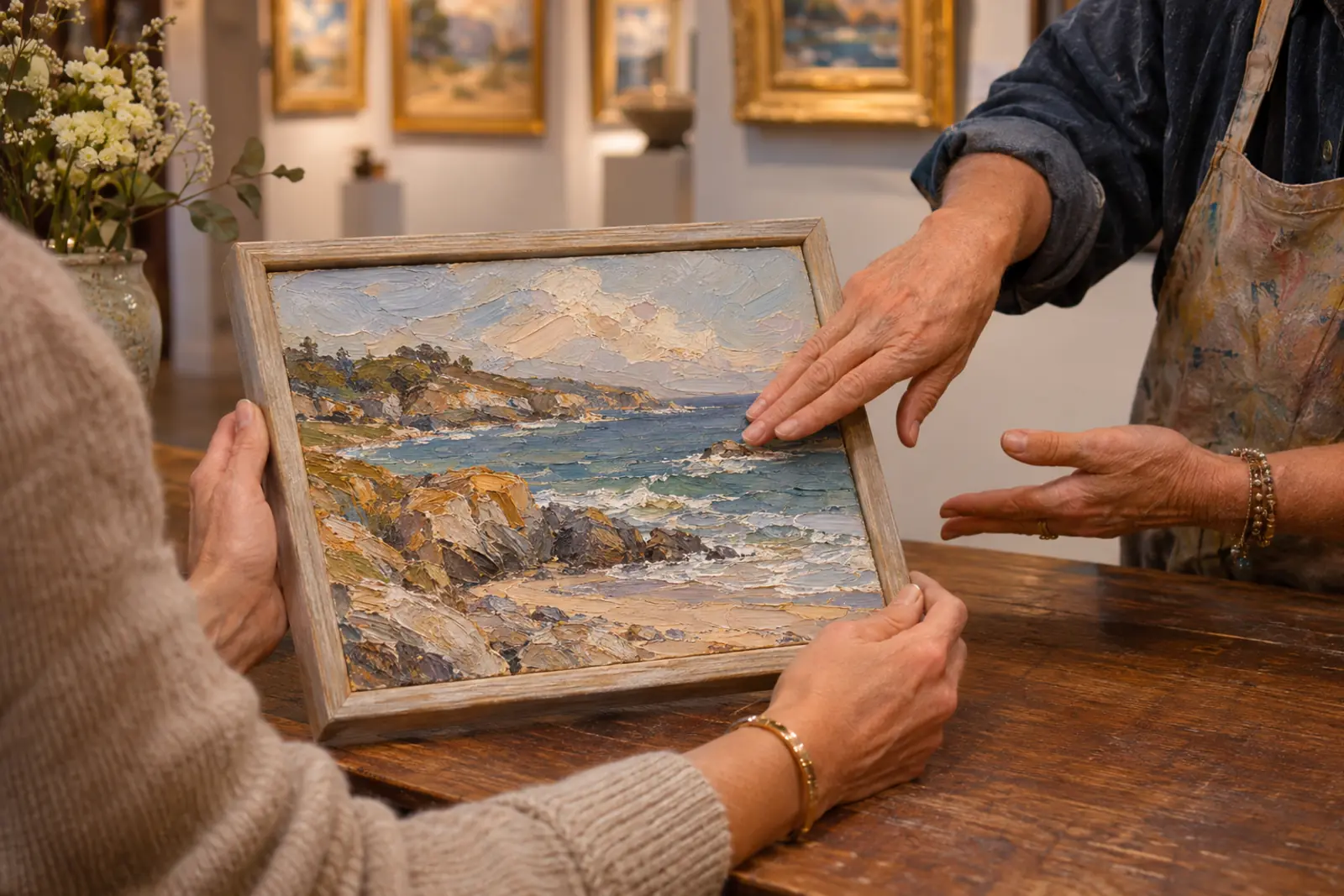
The most common point of confusion at festivals. A canvas print of a painting is not a painting, and the price should reflect that. Look at the surface: an original has brushwork or physical texture; a print does not, unless it has been hand-embellished — which should be disclosed. A limited-edition print carries a number and a hand signature. An open-edition giclée with no stated run size is a quality reproduction; a small numbered limited edition signed by the artist carries more market standing. Ask directly if anything is unclear.
Caring for art in a coastal climate
Humidity, salt air, and heat are the three main threats to a Southwest Florida collection. The recommended range for most artworks is 45–55% relative humidity at a stable temperature; fluctuations cause canvas and paper to expand and contract, eventually leading to cracking or warping. Hang work on interior walls away from HVAC vents and exterior walls that absorb moisture. Use UV-filtering glazing on works on paper and photographs, and keep any original out of direct sun. A house closed for the summer without climate control will almost certainly develop foxing or mold on paper pieces by September; a dehumidifier set to around 50% is a reasonable minimum for a seasonal residence.
Documentation and insurance
Get a receipt with the title, medium, dimensions, year, and artist name. For anything above a modest sum, ask for a certificate of authenticity — a document signed by the artist or their gallery that records the work and its details. Photograph the piece and store the documentation separately from the artwork itself.
Standard Florida homeowners insurance covers personal property including art, but typically only up to a per-category sublimit. That ceiling is too low for a collection of any depth. If the value of your pieces exceeds standard limits, ask your broker about a scheduled personal property endorsement or a fine arts floater, both of which provide replacement-value coverage and protect against risks that standard policies exclude, such as accidental breakage or transit damage.
Frequently Asked Questions
When is the best time to buy art in Southwest Florida?
November through April is peak season: galleries run their strongest shows, outdoor festivals are concentrated, and open studio tours are most frequent. Studios and smaller galleries often reduce hours or close entirely from May through October. For juried exhibitions, the opening night is when the most desirable work sells — come early and be ready to decide.
What is the difference between a giclée print and an original?
An original is the one-of-a-kind object the artist made — a painting, drawing, or sculptural work. A giclée is a high-resolution inkjet reproduction on archival paper or canvas. A numbered limited edition giclée hand-signed by the artist is a collectible print with legitimate market standing. An open-edition giclée with no stated run size is a quality reproduction — worth buying for its own sake, but not comparable to an original or a limited edition in resale terms.
What are Florida Highwaymen paintings?
The Florida Highwaymen were roughly 26 self-taught African American landscape painters who emerged in the late 1950s, painting vivid Florida scenes on Upson board and Masonite and selling them roadside across the state. Their work now trades at galleries and auction, with prices ranging from a few hundred to several thousand dollars depending on the artist, condition, and documentation. Because forgeries and misattributions are known to exist in this market, a certificate from a recognized specialist matters more than in most other buying contexts. The Florida Highwaymen collector's guide covers authentication and what to look for.
Should I buy original art as an investment?
Most art does not appreciate in value, and buying with an expectation of profit leads to disappointment more often than not. The more durable reason to collect is that you want to live with the work every day. If a piece holds or grows in value over time, that is a bonus — not the reason to acquire it in the first place.