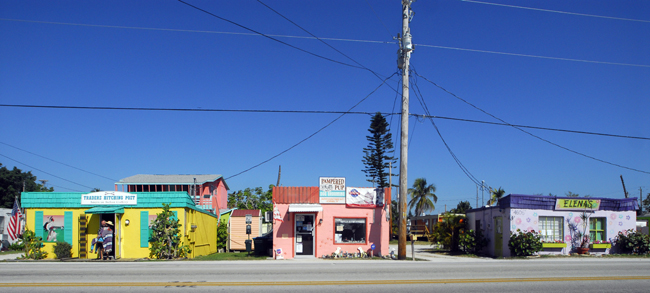
Matlacha - pronounced Mat-la-SHAY, a Seminole place name meaning Big Warrior - sits on a narrow strip of land between Cape Coral and Pine Island, connected to both by a low bridge that most drivers cross without slowing down. That is a mistake. The commercial strip runs for roughly two blocks along Pine Island Road, and almost nothing about it resembles the rest of Southwest Florida. The buildings are one-story wood-frame bungalows painted in colors that would look reckless anywhere else - citrus orange, turquoise, acid yellow, coral pink. Galvanized tin roofs. Hand-lettered signs. Sculptures that drift out from open doorways onto shell-covered ground. The water is everywhere, occupying roughly 71 percent of the island's approximately 440 total acres, so the light bounces off it at all angles and the air smells like salt and low tide. The permanent population is a little under 850 people, which means the community is intimate in a way that actual resort towns are not. Matlacha is unincorporated Lee County - not part of Cape Coral, not part of any municipality at all - which partly explains why it has stayed the way it is.
The Bridge and the Footprint
The bridge itself is worth pausing for. Coming from Cape Coral, the causeway drops you onto the island at road level with the water tight on both sides. Fishing poles lean against the bridge railings on most days, and there is usually a pelican or two working the same stretch of water. The commercial center is genuinely small - a visitor who walks the full length of Pine Island Road's gallery district will cover it in under fifteen minutes even stopping to look in windows. That smallness is not a deficiency. It makes the place legible in a way that sprawling arts districts rarely are. You can compare what you saw at the first gallery against what you're looking at in the third without losing track of the conversation. And the size forces a kind of contact between visitor and artist that larger venues avoid: in a one-room converted bait house, there is nowhere for the person who made the work to disappear.
The 1994 Net Ban and the Colony That Grew From It
The story of how Matlacha became an art colony begins with a vote, not with a vision. In 1994, Florida voters approved a constitutional amendment banning gill nets in state waters. The ban was aimed at protecting fish populations, and it was effective - but it ended commercial fishing in communities that had depended on it for generations. Matlacha was one of those communities. The fishermen who had worked Pine Island Sound for mullet and other species found their livelihood legally closed. Reports from the time describe men burning their boats on the shore in protest, which captures something true about the magnitude of what was lost. The fish houses, bait shacks, and waterfront buildings that had served the fleet were suddenly vacant.
Artists moved in almost immediately. The rents were low, the buildings were small and eccentric, and the light off the water was remarkable. By the mid-1990s a loose community of painters, sculptors, and craftspeople had occupied much of what the fishing industry had left behind. What preserved that character over the following three decades was not sentiment but zoning. Lee County enacted an ordinance restricting building height and prohibiting large-footprint new construction in the commercial strip. The original one-story bungalow scale was locked in by law. No developer could come in and replace a cluster of historic fishing cottages with a three-story retail block. The ordinance is the reason the place still looks the way it does.
The Galleries on Pine Island Road
Several distinct institutions anchor the strip, each with a different collecting focus and atmosphere.
Wild Child Gallery
Wild Child Gallery operates from a converted historic fishing cottage on Pine Island Road and represents more than 120 Southwest Florida artists. Owner Peggy McTeague has built a collection that spans nearly every medium - oil, acrylic, watercolor, photography, sculpture, pottery, and metalwork. The range is intentional and consequential for buyers: you can walk in looking at a ceramic piece and walk out thinking about a large-format photograph of the Ten Thousand Islands, all within the same 15-minute visit. Because the represented artists are local, the work engages the specific landscape and light of Southwest Florida rather than the generic beach aesthetic that fills resort hotel corridors. McTeague's gallery is one of the most reliable places to find work at multiple price points under one roof.
Traders Hitching Post
Established in 1977, Traders Hitching Post is the oldest continuously operating gallery on the strip. It specializes in authentic Native American jewelry and art - a focus that is genuinely rare in Southwest Florida and that fills a gap no other Matlacha gallery addresses. The building has outlasted everything Ian threw at the island and has been in continuous operation for nearly five decades, which is a record no other gallery on Pine Island Road can claim. If you are looking for work rooted in Seminole or other Indigenous traditions rather than Florida landscape painting, this is the place to start.
The Griffen American Center for Haitian Art
The Griffen American Center for Haitian Art is one of the most distinctive institutions in the village and one of the least covered in existing travel guides. It makes Matlacha one of the only venues in Southwest Florida where Caribbean diasporic work is exhibited alongside local painting and craft. Haitian art has a rich and specific tradition - vivid color, strong narrative content, work that frequently engages spiritual and historical themes drawn from Vodou iconography, the Haitian revolution, and everyday life in the diaspora. The Center brings that tradition into direct conversation with the Florida Gulf Coast context, which produces a viewing experience available almost nowhere else in the region. For collectors with an interest in Caribbean art, or for visitors who want to see something genuinely different from the coastal landscape work that dominates most Southwest Florida galleries, the Griffen Center deserves dedicated time.
Other Studios and Galleries
Beyond these anchors, individual artist studios occupy bungalows throughout the strip. The mix changes over time as artists come and go, and the best way to find current occupants is to walk the road rather than research it in advance. Open doors and hand-lettered signs indicate working studios where the artist is usually present and usually willing to talk about the work. This informal, shifting layer of studios is part of what gives Pine Island Road its character and distinguishes it from a fixed commercial district.
Leoma Lovegrove: Who She Was, What She Built, and What Her Gallery Is Now
Leoma Lovegrove arrived in Matlacha in 1994, the same year the gill-net ban took effect and artists began occupying the vacant fishing buildings. She was a Ringling College of Art and Design graduate, and she built a reputation in the village quickly. In 1998 she purchased a small wood-frame building on Pine Island Road that became Lovegrove Gallery and Gardens - a studio, gallery, and landscaped outdoor space that became one of the most visited destinations on the island. Her paintings entered the permanent collection of the White House and the George W. Bush Presidential Library in Dallas. She was honored at a White House reception hosted by First Lady Laura Bush. The local designation "First Lady of Matlacha" was not formal but it was genuine: she was the most nationally recognized artist the village had produced and one of the people who had given the colony its early shape and momentum.
Lovegrove was diagnosed with stage-four breast cancer seven years before her death and spoke about it publicly and directly, using her platform to push for early screening. She died on April 10, 2025, at age 72. Her death left an immediate question about the gallery's future. As of late 2026, that question is not fully resolved - visitors should check current information before planning a visit specifically around the gallery, since operating status and programming may have changed. What is not uncertain is Lovegrove's place in the history of the colony. She was one of the people who made the transition from fishing village to art community legible to the outside world, and the building she occupied on Pine Island Road remains a physical marker of that history regardless of what happens to it institutionally.
The Pine Island Art Association: Classes, the Annual Juried Show, and the Restored Fire Station Building
The Pine Island Art Association was founded in 1974, which makes it one of the older continuously operating visual art organizations in Southwest Florida. It has more than 200 members and operates its gallery and teaching studios from a building with genuine local history: the former Matlacha Fire Station on Pine Island Road. The building's conversion from civic infrastructure to art institution is itself a legible piece of Matlacha's history.
The Association's teaching program spans multiple mediums and skill levels, and its annual membership carries a fee that the organization describes as accessible - check piaa.org for the current amount before planning around it, since fees are updated periodically. Membership provides access to workshops, studio space, and the community of working artists the organization has built over five decades.
The Annual Juried Art Show is the PIAA's signature event. The 2026 edition is approximately the 54th, which places it among the longest-running juried exhibitions in the Southwest Florida region. The show brings in work from across the membership and beyond, and it is one of the best opportunities to see the range of serious work being produced in the Pine Island and Matlacha community at any one time.
Hurricane Ian closed the Fire Station gallery for more than three years. The restoration was extensive, and the building reopened in early 2026. The reopening is significant not only for the PIAA but for the village's recovery more broadly - the Fire Station gallery is an institutional anchor, and its absence for three-plus years left a gap in the community's artistic infrastructure that the new programming is working to fill.
The Art Walk: Every Second Friday, How It Works, and What to Buy
The Matlacha Art Walk runs on the second Friday of every month from 5 to 8 pm. It was revived on June 13, 2025 by Jennifer Rena Bennett of Island Flair in partnership with the Matlacha Civic Association. The revival followed the disruption of Hurricane Ian and the slow recovery of the village's commercial life. More than 30 vendors regularly participate, and galleries keep their doors open past their normal hours for the duration.
The Art Walk is worth understanding as a buying context, not just a browsing one. The evening format and the density of participating galleries create a compressed opportunity to compare work across styles, mediums, and price points in a single visit. Artists are typically present, which means buyers can ask direct questions about process, materials, and the specific geography that generated a piece. This kind of access is unusual in a retail art context.
What you can typically expect to find at an Art Walk:
- Paintings in oil, acrylic, and watercolor oriented to the Southwest Florida landscape and water
- Photography of local wildlife - roseate spoonbills, ospreys, manatees, and the Ten Thousand Islands
- Ceramics and hand-thrown pottery from resident studio artists
- Jewelry, metalwork, and sculpture from independent makers
- Caribbean and diasporic work from the Griffen Center and associated artists
- Native American jewelry and craft from Traders Hitching Post
The Art Walk is also a reasonable test run for a purchase you're considering from a gallery visit earlier in the day. Many galleries on the strip are open during the day and again during the walk, so you can look at a piece twice before deciding.
Buying Art in Matlacha vs. Buying in Naples
The practical differences between buying art in Matlacha and buying in Naples are real and worth understanding before you go.
| Factor | Matlacha | Naples (5th Avenue / Crayton Cove) |
|---|---|---|
| Price range | Lower to mid-range; accessible entry points common | Mid to high; significant works priced accordingly |
| Gallery format | Small converted bungalows; artist often present | Larger white-box commercial galleries; staff may not be the artist |
| Artist access | High; direct conversation typical | Lower; appointments sometimes needed for studio access |
| Collecting focus | Local landscape, craft, Caribbean diasporic, Indigenous | Broader range including national and international artists |
| Atmosphere | Informal, outdoor elements, working studio feel | Polished retail environment, curated presentation |
Matlacha's galleries are not lesser versions of Naples galleries - they are oriented toward different things. Work sold in Matlacha is almost entirely produced by people who live and work in the immediate region, which gives it a specificity that the broader Naples market does not always prioritize. If you want a large-scale investment-grade work from an artist with national gallery representation, Naples is the more likely source. If you want a painting made by someone who fished the same waters the painting depicts, or a ceramic piece thrown in a studio 200 feet from where you're standing, Matlacha is the more direct route.
Practical notes for buying in an open-studio bungalow setting:
- Ask about framing and packaging - small studios may not carry standard framing for larger works, and you should know this before you commit
- Ask whether the artist ships - many do, and domestic shipping for flat work is common; large sculpture or ceramics is more variable
- Ask about the story behind the piece - the artist is usually there and usually glad to talk; this information also becomes part of the value of the work
- Bring cash as a backup - most studios take cards, but connectivity is occasionally an issue on the island
Most galleries on Pine Island Road are single rooms where the person who made the work is also the person at the desk. A buyer who asks about materials, the location depicted, or whether a piece ships gets an answer from the source rather than from a staff member reading a label. That is not how most retail art transactions work.
Hurricane Ian and the Recovery: What Was Lost, What Came Back, and What Is Still Missing in 2026
Hurricane Ian made landfall in Lee County on September 28, 2022, as one of the most powerful storms to hit Southwest Florida on record. The storm surge flooded virtually every gallery and business on Pine Island Road. The Pine Island Causeway - the only road connecting Pine Island and Matlacha to the mainland - was impassable for weeks after landfall. The island was cut off at precisely the moment it most needed supplies and repair crews.
What Was Damaged
The damage to Matlacha was not uniform, but it was comprehensive. Low-lying bungalows that had survived previous storms took direct surge flooding. Art inventory, studio equipment, and finished work were lost. Some galleries were able to preserve what was on upper display surfaces or in elevated storage; others lost essentially everything at floor level, which in a one-story bungalow means everything.
The Recovery Timeline
Recovery in Matlacha has been slower and more uneven than the recovery of better-resourced parts of Lee County. The FEMA process, insurance claims, and the practical difficulty of restoring historic wood-frame buildings took time that larger commercial properties did not require. The Pine Island Art Association's Fire Station gallery was closed for more than three years, reopening in early 2026. Some individual studios and galleries that had operated before Ian have not returned. Others reopened within months.
The Art Walk's revival in June 2025 - more than two and a half years after Ian - is a reasonable marker of where the community stood at that point: enough had been restored to support 30-plus vendors and a regular monthly event, but the revival itself was notable enough to be named and dated, which suggests it was not a simple resumption of a continuous tradition.
What Visitors Should Know in Late 2026
- The PIAA Fire Station gallery is open again as of early 2026, but check piaa.org for current hours and programming
- The Art Walk is active and regular as of mid-2025, running every second Friday
- Some studios and galleries that existed before Ian have not reopened; the strip is still missing some businesses that were there before the storm
- Lovegrove Gallery and Gardens faces its own transition independent of Ian, following Lovegrove's death in April 2025
- Road and causeway access has been restored; getting to the island is no longer the issue it was in late 2022
Matlacha's recovery is a work in progress, and that is worth acknowledging honestly. The village is functional, the galleries are open, and the Art Walk is running. But "mostly recovered" is a more accurate description than "fully recovered," and visitors who knew the strip before Ian will notice absences.
Getting There and When to Go
Matlacha sits at the western end of the Pine Island Causeway, accessible from Cape Coral via Pine Island Road. From Fort Myers, the drive runs approximately 30 to 35 minutes depending on the Cape Coral bridge crossing you use. From Naples, the drive is closer to an hour. From Sanibel, crossing the Sanibel Causeway to Fort Myers and then heading north through Cape Coral adds up to roughly 45 to 55 minutes depending on traffic at the Sanibel toll plaza.
Combining Matlacha With Other Destinations
Matlacha works well as part of a day that moves between destinations on the barrier islands and Pine Island Sound.
- Start on Sanibel in the morning before beach traffic builds, and visit the Bailey-Matthews National Shell Museum or walk the Ding Darling Wildlife Refuge roads early when bird activity is highest.
- Cross back to Fort Myers and head north on US-41 or through Cape Coral to reach Pine Island Road by midday.
- Spend the early afternoon in Matlacha - the galleries open mid-morning and the light is good through mid-afternoon, particularly for seeing how paintings interact with natural illumination. Plan for two to three hours if you are going inside each gallery and stopping to talk.
- Continue west on Pine Island Road to Bokeelia or St. James City at the southern tip of Pine Island, where working waterfront and fishing culture remain intact in a way that is different from but complementary to Matlacha's gallery character.
- Return to Matlacha for the second Friday Art Walk if your visit aligns with the schedule.
Season and Timing
Southwest Florida's high season runs from roughly November through April, when northern visitors fill the region and gallery traffic is at its peak. This is the best time to find the full roster of galleries open with extended hours, and it aligns with the most comfortable outdoor temperatures for walking Pine Island Road. Summer visits are possible and the crowds are lighter, but heat and afternoon thunderstorms compress the usable outdoor hours. Hurricane season runs from June through November, with the peak risk window in August and September - Ian made landfall in late September, which is within the statistical peak.
The Art Walk runs year-round on the second Friday, which means it is available during both the high and off seasons. If a specific event like the PIAA Annual Juried Show is part of your planning, check piaa.org for current scheduling, as exact dates shift year to year.