Southwest Florida is not a typical regional art market. The corridor running from Naples through Bonita Springs and Fort Myers holds a concentration of privately owned fine art that rivals cities many times its size - driven by decades of seasonal migration from the Northeast, Midwest, and abroad. When those residents downsize, relocate, or pass on their estates, art comes to market in patterns unlike anywhere else in the country. Understanding who the players are, how the auction calendar works, and what the process looks like from first inquiry to final sale puts you in a fundamentally different position, whether you are buying, selling, or settling an estate.
Why Southwest Florida Has Its Own Distinct Auction Market
The seasonal structure of Southwest Florida life creates a built-in rhythm that shapes when and how art surfaces here. Collectors from Chicago, New York, Boston, and Toronto have maintained winter residences in this region for generations, bringing serious collections south. Many of those collections were never intended to stay permanently - they traveled with their owners and accumulated quietly in waterfront homes and gated communities far from public view.
The density of that wealth is measurable in concrete ways. The Naples Winter Wine Festival, held annually since 2001, raises remarkable sums for Collier County children's programs through live auction events - its cumulative total across two-plus decades runs into the hundreds of millions of dollars, with individual recent years each generating extraordinary results from a single evening's live auction. No auction house opens a regional office in a city the size of Naples on a hunch. Freeman's | Hindman established its Naples location specifically because the concentration of collectors here justified it - the firm's first regional office anywhere in the country.
The spring surge is the engine of the local market. When seasonal residents leave in April and May, estate attorneys, financial planners, and family members begin the process of evaluating, appraising, and liquidating household contents. This creates a compressed window of consignment activity that feeds auction calendars through the summer and fall. Categories that rarely appear in volume in inland markets surface here regularly because the collecting habits of the seasonal population reflect their lives in other cities and other decades.
The Auction Venues Operating in the Region
Southwest Florida supports a range of auction operations, from a nationally known fine art house to specialized estate liquidators. Each fills a distinct role in the market.
| Venue | Primary Specialty | Sale Format | Geographic Reach |
|---|---|---|---|
| Freeman's | Hindman (Naples) | Fine and decorative art, jewelry | Live and timed online | National and international |
| Auctions Neapolitan | Estate contents, furniture, art | Gallery auction, onsite estate sales | Regional with worldwide online reach |
| Kings Estate Sales | Full-home estate liquidation | Onsite estate sales | Local and regional |
| Florida Estate Sales Inc. | Estate contents | Online via LiveAuctioneers | National online reach |
| Cottone Art Advisory and Prestige Estate Services | Appraisals, advisory | Service-based (not auction) | Regional, institutional clients |
Freeman's | Hindman - Naples
The Naples office opened in 2010, well before the January 2024 merger that combined Philadelphia's Freeman's - founded in 1805, making it the oldest auction house in America - with Chicago's Hindman, founded in 1982. The combined firm now operates six salesrooms and eighteen regional offices nationally. Property consigned through Naples moves into more than a hundred live and online auctions per year, reaching collectors worldwide rather than being sold locally. Past Naples-sourced sales have included works by Picasso, Frank Stella, Roy Lichtenstein, and Colombian textile artist Olga de Amaral - that roster reflects the actual quality of collections held here.
Auctions Neapolitan
Operating as a division of Dovetails LLC, Auctions Neapolitan describes itself as the largest estate liquidation service in Southwest Florida. Gallery auctions typically run on Wednesday afternoons; onsite estate sales run on weekends. An extensive archive of past catalogs is listed on LiveAuctioneers, the dominant online bidding aggregator, meaning any sale they run is visible and biddable by buyers anywhere in the world in real time.
Kings Estate Sales
Kings has operated in the Naples area for more than three decades - long enough that its auction calendar explicitly tracks the seasonal estate surge. Relationships with estate attorneys and property managers mean it often handles contents before a house reaches the real estate market. For buyers, it is a practical source for furnishings and decorative objects from estates that did not require white-glove consignment handling.
Cottone Art Advisory and Prestige Estate Services
Cottone, based in Fort Myers, provides USPAP-compliant appraisals for individuals, museum collections, executors, and banks - one of the few firms in the region explicitly built to serve institutional and estate clients at the documentation level those engagements require. Prestige Estate Services maintains offices serving both Naples and Fort Myers with a specific focus on personal property appraisals. These firms are not auctioneers; they operate in the service layer that feeds the auction market and the legal system surrounding it.
How to Read an Auction Listing Before You Bid
A catalog entry is a summary, not a guarantee. Understanding each component before you bid is basic protection.
- Lot estimates: The pre-sale range reflects the specialist's opinion of likely hammer price. A lot can sell above or below it - estimates are not promises, and they do not set a floor.
- Condition reports: Most houses provide condition reports on request, and some publish them in the catalog. Read them carefully. Auction condition language has specific meanings - "scattered restoration" is different from "touches of inpainting," and neither is the same as "excellent condition."
- Provenance notes: A documented chain of ownership matters for authentication and for value. "Property of a private collector" tells you almost nothing; a named collection or exhibition history adds real substance to the attribution.
- Reserve pricing: The reserve is a confidential minimum set by the seller. You will not see it in the catalog, but lot estimates usually give a signal - most houses set reserves below the low estimate. If bidding stalls below reserve, the lot is passed, or "bought in," and does not sell.
- Attribution language: "By Picasso" means the house attributes the work directly to the artist. "Attributed to Picasso" is a weaker claim. "Circle of Picasso" suggests it came from the artist's studio or immediate followers. "After Picasso" means it is a copy. These distinctions are not stylistic - they are material to value.

Understanding the Buyer's Premium and True Purchase Cost
The hammer price - the amount called when the gavel falls - is not what you pay. On top of it, you owe the buyer's premium, an additional percentage fee charged by the house. The structure is typically tiered, with a higher percentage applying to the initial portion of the hammer price and a lower rate above a threshold. The exact structure varies by house and changes over time - check the conditions of sale before you bid, not after. Some online bidding platforms also add their own small fee on top of the house's premium.
In Florida, sales tax applies to auction purchases unless a specific exemption covers your situation, such as a resale certificate for dealers. Tax is generally calculated on the total amount paid including the buyer's premium. Before you raise your paddle or click bid, do the math with the correct premium rate and applicable tax applied to your maximum hammer price. The number you arrive at is your actual maximum spend - not the estimate in the catalog.
Online Bidding and Remote Access
LiveAuctioneers is the dominant platform through which Southwest Florida estate sales reach buyers outside the region. Multiple major local operators list through it, meaning a buyer in Toronto or Chicago can bid in real time on a Naples estate sale without visiting. Freeman's | Hindman uses its own online bidding infrastructure in addition to third-party platforms, distributing Naples-consigned material across the firm's full national client network.
Before bidding online for the first time through any platform, verify these points:
- Whether the platform charges an additional fee on top of the house's buyer's premium - some do, for online bidding specifically
- Who is responsible for shipping and what it realistically costs - online bidders arrange and pay for their own shipping, and for large or fragile works this can add significantly to total cost
- Whether condition reports are available before the sale closes and how to request them
- What the return policy looks like, if any exists - most auction sales are final, and online buyers often have fewer remedies than in-room bidders
When Southwest Florida Art Comes to Market
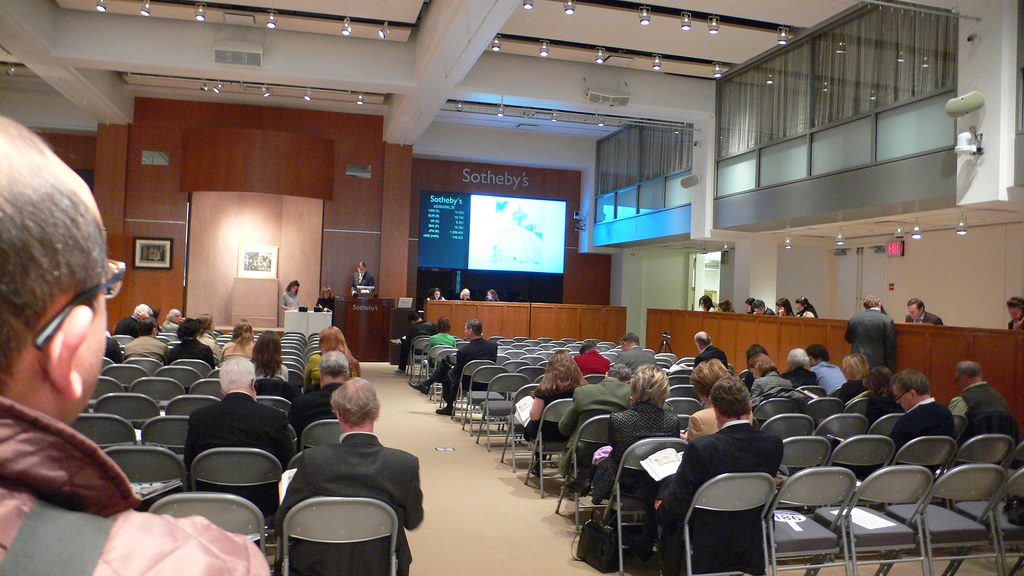
The auction calendar here mirrors the residential calendar in ways that are structurally unique to this region. January through March is peak season - estates are active, properties are occupied, and discretionary sales are common but not yet urgent. April and May are the transition months, when consignment inquiries spike as seasonal residents prepare to leave. Estate attorneys schedule property reviews, auction houses see their heaviest intake of new material, and the volume of work entering the pipeline is at its annual high.
June through August is when that material reaches the auction floor, often in volume sales timed to move content efficiently. Fall brings a second, smaller wave as estates settled over the summer reach the market and seasonal residents begin returning. The period from November through January is typically lighter for estate liquidation but active for fine art sales timed to the returning collector population.
Certain categories appear in Southwest Florida sales more often than in comparable markets - driven by the specific collecting habits of the seasonal resident population:
- Latin American modernism, reflecting connections of seasonal residents with Miami and international travel
- Mid-century American prints and multiples, accumulated by collectors who were active buyers in New York during the 1960s through the 1980s
- European decorative arts and furniture from estates assembled across long collecting lifetimes
- Jewelry of serious quality, which typically routes to Freeman's | Hindman rather than to local estate sales
Getting an Appraisal in Southwest Florida
The word "appraisal" covers three legally distinct things, and using the wrong type for the wrong purpose can cost you money or a tax deduction.
The type of value an appraisal establishes - insurance replacement, fair market, or estate tax value - is not interchangeable. A number prepared for one purpose produces the wrong result if used for another.
The Three Appraisal Values
Fair market value is what a willing buyer would pay a willing seller, with neither under compulsion and both having reasonable knowledge. This is the correct standard for estate tax and for IRS charitable contribution deductions. It is almost always lower than what you paid at retail and lower than what replacement would cost.
Insurance replacement value is what it would cost to replace the object with one of comparable quality in the current retail market. Because it reflects gallery or dealer pricing, it is typically the highest of the three figures - which is appropriate for coverage purposes but not for tax calculations.
Estate tax value uses fair market value but with specific requirements about the date of valuation, who performed the appraisal, and how the report is documented for submission to tax authorities.
For IRS purposes, donating art to a museum or nonprofit requires a "qualified appraisal" from a "qualified appraiser" meeting USPAP standards. This requirement kicks in above a specific donation value threshold - check IRS.gov for the current figure, as the threshold can be adjusted. For claimed deductions above a second, higher threshold, the signed appraisal must be physically attached to your tax return when you file - not merely available if requested, but attached. The IRS has disallowed deductions not because an appraisal was absent but because it was not attached. There is also a timing constraint on when relative to the contribution the appraisal may be completed - again, IRS.gov has the current rule.
Cottone Art Advisory in Fort Myers and Prestige Estate Services, serving both Naples and Fort Myers, each provide USPAP-compliant appraisals and explicitly serve executors, banks, and estate attorneys. If you are working through a probate process, confirm that your appraiser is experienced with estate and fiduciary clients - the documentation standards are more demanding than a straightforward insurance appraisal.
Consigning Art Through a Southwest Florida House
The consignment process follows a consistent sequence regardless of which house you work with. Understanding each step prevents surprises.
- Initial review: Submit photographs and any documentation you have - receipts, prior appraisals, exhibition history. The specialist gives a preliminary opinion on whether the work suits the house's sales and at what level.
- In-person evaluation: For anything significant, the specialist will examine the work directly. Freeman's | Hindman can handle this at the Naples office or make arrangements for works requiring transport.
- Consignment agreement: This document sets the seller's commission, the sale the work will enter, the estimate range, and the reserve. Read it carefully - it specifies what happens if the work does not sell, how unsold lots are returned, and what storage or insurance fees may accrue during the consignment period.
- Reserve-setting conversation: The house suggests a reserve based on the estimate. You can negotiate this. Setting it too high kills the sale; setting it too low risks a result you will regret. The house has an interest in a sale happening, which makes their advice useful but not perfectly aligned with yours.
- Cataloging and marketing: The work is photographed, researched, and listed. For Freeman's | Hindman this means distribution across their national and international auction schedule. For local estate houses it means LiveAuctioneers listing plus local outreach.
- Sale and settlement: After the hammer falls, settlement typically takes several weeks. The house deducts its seller's commission and applicable fees before remitting net proceeds.
Deciding Between Local and National Consignment
The decision usually comes down to the nature of the work. Decorative objects, regional art, furniture, and household contents sell best and fastest locally, where buyers can inspect and collect without shipping complexity. Fine art by nationally or internationally known artists, important jewelry, and documented antiques of real value benefit from national exposure - which in practice means routing them through Freeman's | Hindman's broader sale schedule rather than any local estate sale, regardless of convenience.
Charity Auctions and the Philanthropic Collector Culture
Southwest Florida's philanthropic culture shapes the commercial auction market in ways worth understanding as both a buyer and a seller. Museum benefit sales - the Baker Museum in Naples and the Sidney and Berne Davis Art Center in Fort Myers - regularly feature works that would be competitive in much larger markets. The audience at those events overlaps substantially with the collector base that uses commercial auction venues, and the habits of competitive live bidding that develop in benefit contexts carry into commercial settings. Collectors here treat high-value auction participation as routine in a way that buyers in markets where auction is an unusual transaction type simply do not.
For sellers, this philanthropic density indicates a real buyer pool with genuine financial depth. For buyers, it means that charity auction lots sometimes carry a premium driven by the social and emotional context of the event rather than pure secondary market value. That is not a reason to avoid benefit sales - but it is worth holding in mind when evaluating whether to pursue a lot at a museum benefit versus a commercial sale with the same work.
Frequently Asked Questions
How do I find out when Southwest Florida estate sales are scheduled?
LiveAuctioneers is the most comprehensive single source - search by location to surface active listings from Auctions Neapolitan, Florida Estate Sales Inc., and other regional operators with upcoming sales. Freeman's | Hindman posts its full sale schedule through its own channels, and the Naples office can advise on upcoming sales relevant to specific categories you collect. Local firms like Kings Estate Sales often maintain mailing lists worth joining if you are actively looking in this market.
Can I bid on a Southwest Florida estate sale if I live in another state?
Yes, and buyers from outside the region are common at every level of the market. Most regional estate sales now list through LiveAuctioneers or similar platforms, where you register, bid in real time, and arrange your own shipping after winning. For higher-value lots, calling the house directly before the sale closes to ask about condition and confirm registration is always a reasonable step, regardless of where you are based.
What is the difference between a seller's commission and a buyer's premium?
Both are percentage fees charged by the auction house, but they move in opposite directions: the buyer's premium increases what you pay above the hammer price, while the seller's commission reduces what you receive from it. The practical consequence is that buyers and sellers both need to calculate their real numbers before committing - buyers by applying the premium rate and applicable tax to their ceiling hammer price, sellers by asking the specialist for a net proceeds estimate at the low and high estimate range before signing the consignment agreement. On higher-value lots, both fees are negotiable, and the house will discuss terms with serious consignors or large-volume buyers.
Do I need a USPAP appraisal to donate art to a museum in Southwest Florida?
The IRS and the museum receiving the gift have separate documentation requirements, and satisfying one does not automatically satisfy the other. The museum's development office will have its own standards for accepting a gift; the IRS requires a qualified appraisal from a qualified appraiser meeting USPAP standards, completed within a defined window relative to the contribution date, and the appraisal must use fair market value - not insurance replacement value, even if you have a recent insurance appraisal on file. Check IRS.gov for current thresholds and timing rules, and confirm with the museum what it needs before arranging the appraisal. Cottone Art Advisory in Fort Myers is specifically configured for these engagements.
What happens if my consigned work does not sell?
A passed lot - one that did not reach its reserve - is returned to the seller, but you typically owe the house a reduced fee even without a sale, as specified in the consignment agreement. Your options afterward include adjusting the reserve and entering the work in a later sale, withdrawing it entirely, or trying a different venue. Talking through the reserve level carefully before signing the consignment agreement is one of the most important conversations you will have in the whole process - an overly optimistic reserve is one of the most common reasons consigned works go unsold.
Is there a best time of year to consign art in Southwest Florida?
For local estate sales, consigning in the spring surge means your work enters a market flooded with competing material, which can work against you. For fine art consigned to Freeman's | Hindman's national sales, timing is less about the local calendar and more about which sale category suits your specific work - the specialists there will advise on placement. In general, works of genuine quality move regardless of season; the spring surge intensifies competition for the house's attention, not for buyers.