Southwest Florida's fiber arts scene runs deeper than most visitors expect. Drive through Naples or Fort Myers in season and the gallery walls are hung with oil paintings and bronze pours - but look for the guilds, and you find something else entirely: hand-coiled pine needle baskets with amethyst-set bases, floor loom cloth woven from handspun fiber, felted work, naturally dyed scarves. The people making this work have organized into active guilds, hold dedicated gallery space, and run public workshops year-round. No single guide has mapped the full landscape - guilds, working artists, and where to buy or study - until now.
What Fiber Art Means in This Context
Fiber art covers a wider range than most people assume. In Southwest Florida, that range includes:
- Coiled basketry - building a vessel by wrapping bundled plant material into a continuous spiral and stitching each coil to the last
- Plaited and twined basketry using flat plant strips or grass blades
- Hand weaving on floor looms, rigid heddle frames, and inkle looms
- Hand spinning on drop spindle or wheel, turning raw fiber into yarn or thread
- Wet and needle felting, which mats fiber into cloth or sculptural forms without weaving
- Natural dyeing using plant- and mineral-based colorants
- Embroidery, quilting, and knitting as practiced within a broader fiber tradition
Florida's subtropical environment shapes these practices in specific ways. The humidity that most newcomers dislike is exactly what keeps plant materials workable. Pine needles cure flexibly in warmth. Native grasses hold structure through the wet and dry seasons. Artists can gather, dry, and process material across most of the calendar year. The landscape itself - pine flatwoods, coastal prairie, salt marsh edges - provides a living palette for those willing to learn it.
The Native Materials
Longleaf Pine Needles
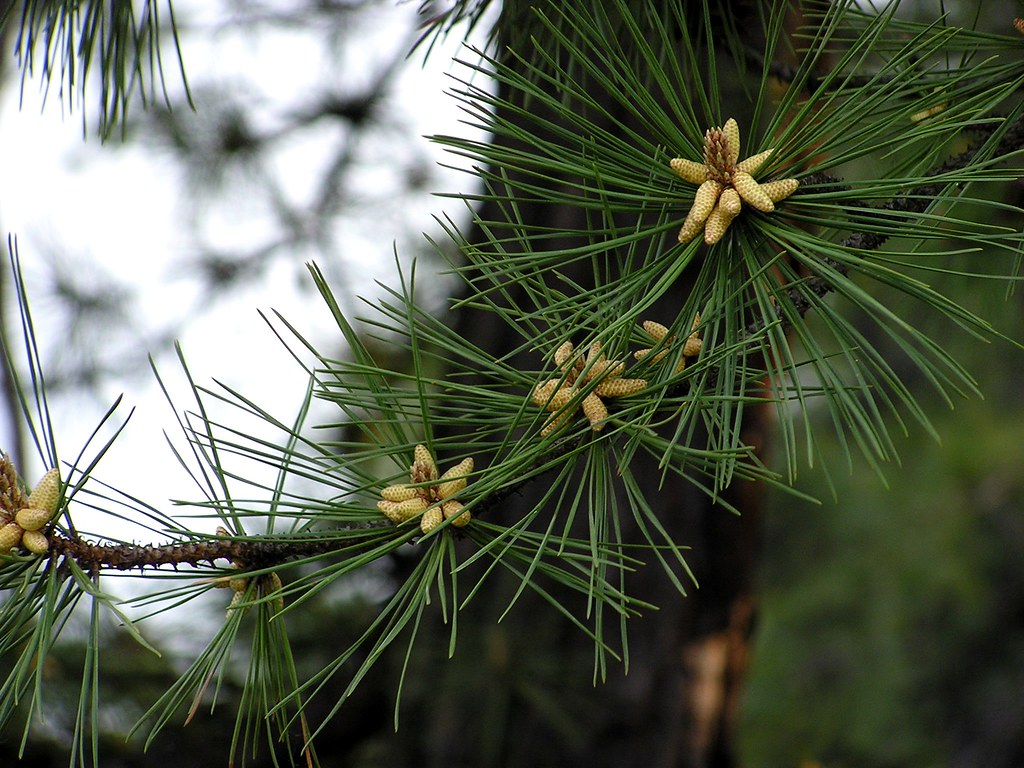
Longleaf Pine needles are the most widely used native basketry material in the region. The needles fall throughout the year and coilers gather them from the ground rather than stripping living trees. Dried and bundled, they form the structural core of a coiled piece - a continuous wrapped spiral stitched row by row into a vessel. The finished material is dense, firm, and faintly aromatic. Pine needle work made with care lasts for generations if kept dry and out of direct sun.
Sweetgrass, Muhly Grass, and Sabal Palm Fiber
Sweetgrass basketry has a long tradition along the American South's coastal plain. In Florida, native muhly grass and related panic grasses fill a parallel ecological role. Florida's warm, humid conditions support grass growth along roadsides, coastal prairies, and open margins. Artists harvest stems at the right stage of growth, dry them flat, and use them as wrapping fiber or as the primary bundle in a coiled piece.
Sabal Palm - Florida's state tree - provides Sabal Palm fiber, historically used as thread to stitch coiled grass baskets together. Florida pioneers built coiled baskets exactly this way: swamp grasses and pine needles bound with palm fiber, a technique documented from the state's earliest settlement period. That same process, using the same plants from the same landscape, continues in the hands of working artists in the region today.
Florida's pioneer basket makers coiled swamp grass and pine needles using Sabal Palm fiber as thread. The artists working at Artisans Village and on Sanibel Island today use the same plants from the same landscape.
The sweetgrass tradition also carries cultural weight. The American South's most celebrated sweetgrass basketry lineage, associated with the Gullah Geechee communities of the Carolina and Georgia lowcountry, arrived in Florida through migration and cultural contact. Artists working here are generally aware of that lineage and the distinction between regional analogue grasses and the original plant.
The Southwest Florida Fiber Arts Guild at Artisans Village
The Southwest Florida Fiber Arts Guild is the newest organized fiber arts group in the region, founded around 2024. It operates as a registered 501(c)(3) nonprofit and maintains its gallery and meeting space at Artisans Village at History Park in Punta Gorda.
The Artisans Village Campus
History Park in Punta Gorda consolidates four distinct craft guilds under one campus: the Southwest Florida Fiber Arts Guild, the Southwest Florida Potters Guild, the Peace River Woodturners, and the SWFL Glass Fusers Foundation. A single visit can move from wheel-thrown ceramics to lathe-turned wood to fused glass panels to coiled pine needle baskets, all within a short walk. No comparable multi-guild campus exists elsewhere in Southwest Florida, which makes the site worth treating as a destination rather than a drive-through stop.
The fiber arts gallery functions as both a public showroom and an active working space. Pieces are displayed with handwritten tags noting materials and price - a direct line from maker to buyer, with no intermediary. The range of scale and technique visible at any time reflects the guild's membership: experienced coilers, weavers, and mixed-media makers working side by side. Some pieces incorporate amethyst-set bases or bead-woven sections, placing them at the boundary between basketry and jewelry-scale craft. These are not decorative flourishes added to plain forms; they reflect deliberate decisions about material and meaning.
Weavers of Char-Lee: Four Decades of Spinning and Weaving
Weavers of Char-Lee is the oldest active fiber arts guild in the region. The organization covers Charlotte and Lee counties, and its first recorded minutes date to February 27, 1986 - placing it more than forty years into continuous operation and among the longest-running craft guilds in Southwest Florida by any measure.
The guild's focus is hand weaving and hand spinning. Members work floor looms, rigid heddle frames, and drop spindles, across traditions that range from Scandinavian linen weaving to contemporary mixed-fiber cloth. Guild meetings combine technical instruction, member project sharing, and informal critique - a structure that has sustained the group across four decades of changing membership.
Roc Day and Public Festivals
Each January, Weavers of Char-Lee marks Roc Day - a European tradition centuries old, celebrating the return to the wheel and loom after the holiday break. The "roc," or distaff, was the tool that historically signaled a spinner's readiness to work; the day became a festive annual restart of the fiber year. The guild's Roc Day events give the public one of its few chances to see hand spinning and floor loom weaving in action outside a museum context.
The guild also appears at ArtFest Fort Myers and Florida Frontier Days in Punta Gorda, where handwoven cloth and handspun yarn meet a general public that may not otherwise encounter guild-quality fiber work. Weavers of Char-Lee participates in the Florida Tropical Weavers Guild's annual spring conference, which draws members from guilds across the state and connects the regional chapter to a statewide network of weavers and spinners - check the Florida Tropical Weavers Guild website for the current year's date and location.
Working Artists to Know
Three artists in the region represent different trajectories within the craft:
- Kathryn Erickson, vice president of the Southwest Florida Fiber Arts Guild, has practiced basketry for more than twenty years and has worked specifically with pine needles since 2002. Her materials come directly from the Florida landscape - fallen Longleaf Pine needles, sweetgrass, muhly grass - gathered and processed by hand. The work reflects the kind of material knowledge that only comes from years of watching how plants behave across seasons.
- Tom Firth, based in Bonita Springs, came to pine needle coiling roughly seven years ago and has built a practice that deliberately mixes traditional plant materials with unexpected found elements: mismatched vintage jewelry embedded in coiled forms, dried gourds incorporated as structural parts of finished pieces. The combination is considered rather than accidental - a conversation between techniques measured in centuries and objects measured in flea market finds.
- Gisela Damandl, based on Sanibel Island, has worked in basketry for more than forty years. She was taught by a Pennsylvania basketeer, representing an unbroken line of direct transmission from teacher to student across generations. She now teaches basketry workshops at BIG ARTS on Sanibel, passing that lineage forward to students who may not know they are entering a chain that stretches back decades.
Where to Take Classes and Workshops
Three institutions offer structured fiber art instruction across the region's five counties, each with a distinct focus and audience:
| Venue | Location | Techniques | Year-Round? |
|---|---|---|---|
| Arts Bonita Visual Arts Center | Bonita Springs, Lee County | Weaving, knitting, quilting, felting, embroidery | Yes |
| BIG ARTS | Sanibel Island, Lee County | Basketry workshops | Seasonal - verify schedule |
| Naples Art Association | Naples, Collier County | Broad arts curriculum - contact organization to confirm current fiber art offerings | Verify with venue |
Arts Bonita's Visual Arts Center in Bonita Springs runs the broadest fiber curriculum in the region. Programming covers weaving through embroidery and runs continuously through the year, not only during the November-through-April tourist peak. This matters for residents who want consistent access rather than seasonal surges.
BIG ARTS on Sanibel is the place to find basketry specifically, including workshops led by Gisela Damandl. The island location makes it slightly less accessible for mainland visitors, but the instruction is grounded in decades of actual practice. The Naples Art Association offers a broad arts curriculum in Collier County - contact them directly to confirm current fiber art offerings and whether fiber work is available in any given term.
Where Fiber Art Appears Publicly
The settings where fiber work appears in public are not interchangeable. A dedicated guild gallery, a general art festival, a historically framed outdoor event, and a professional conference each offer something the others do not - and choosing based on purpose sets the right expectations before you go.
- The Artisans Village gallery at Punta Gorda History Park is the only permanent, dedicated public venue for contemporary fiber art in the region. Work sells directly from the wall, and guild members are often present during open hours - making it the one setting where a visitor can move from seeing a piece to talking with its maker to buying it without leaving the building. That direct access to the artist is not replicated at a festival booth or conference table.
- ArtFest Fort Myers places Weavers of Char-Lee's handwoven and handspun work alongside painting, printmaking, and sculpture. The mixed-media context matters: fiber art reads differently when it is surrounded by oil on canvas and welded metal than it does in a guild gallery. Visitors who would not otherwise seek out a fiber arts venue encounter the work here, which is how the field grows its general audience.
- Florida Frontier Days in Punta Gorda frames guild work within a narrative about regional settlement history. That framing adds documentary weight - a coiled pine needle basket presented at a history festival is offered as evidence of a continuing practice, not only as an object for sale. For artists whose materials come from the same landscape Florida pioneers worked, the setting is not incidental to the work.
- The Florida Tropical Weavers Guild's annual spring conference is the most peer-dense event in the annual calendar. The audience is largely other makers, which shifts what artists bring and what conversations are possible. Work shown there tends toward the technically ambitious, and buyers in attendance are often practitioners themselves - making it the event most likely to yield a purchase accompanied by a substantive exchange about craft.
How to Buy Fiber Art in Southwest Florida
Fine Art Basketry vs. Production Work
The gap between a handcoiled pine needle basket built over many hours by an experienced practitioner and a mass-produced craft fair piece is significant in construction and longevity - but it is not always obvious at first glance. Price alone is not a reliable indicator. Construction is.
Use this sequence when evaluating a piece:
- Pick up the piece and feel the weight. Fine art basketry is dense; coils are tightly packed and the structure feels solid rather than springy or compressed at the edges.
- Look at the coiling from the side. Rows should be even in diameter and the transition from one coil to the next should read as continuous, not stepped or gapped.
- Examine the stitching up close. Each stitch should be consistent in tension and even in spacing. Loose or irregular stitching shortens the life of a piece and is the clearest sign of rushed work.
- Ask about the materials. Artists working with Longleaf Pine needles, muhly grass, and sweetgrass can generally say where their material came from and how it was processed. Vague answers about materials suggest commercial sourcing.
- Ask about finish treatment. Many coilers seal finished pieces with a light wax or fixative. Knowing how a piece was finished tells you how to store and clean it.
Pieces that incorporate unusual elements - embedded vintage jewelry, dried gourds, mineral-set bases - represent original artistic decisions, not shortcuts. Evaluate integration: look at how the added element is anchored structurally, not just placed visually against the coiled surface.
For collectors working off-season, the Artisans Village gallery in Punta Gorda is the most dependable year-round point of access. The Florida Tropical Weavers Guild's annual spring conference is the best single opportunity to see a concentrated range of work from Florida-based makers in any given year - check the guild's website for current dates. Artists also sell directly through guild channels, and a message to the guild is often the fastest path to finding specific work between public events.
Frequently Asked Questions
Do I need prior experience to join a fiber arts guild in Southwest Florida?
Neither the Southwest Florida Fiber Arts Guild nor Weavers of Char-Lee requires prior experience for membership. Both organizations welcome beginners alongside experienced practitioners. The Fiber Arts Guild is recently founded, which makes this a good moment to join while the community is still forming. Weavers of Char-Lee's four-decade membership has accumulated deep collective knowledge in spinning and weaving that benefits newcomers directly.
Can I gather my own basket-making materials from the Florida landscape?
Longleaf Pine needles can be gathered from the ground throughout the year - the trees drop needles continuously, and collecting from the ground does not harm living trees. Public lands are generally an option, though access rules vary by site; check with the relevant land management agency before harvesting. Sweetgrass and muhly grass require harvesting at the right stage of growth and drying flat before they are workable, which demands more timing and preparation than pine needle collection. Most beginners start with pine needles for this reason: the material is immediately accessible, forgiving to process at home, and is the primary focus of regional instruction. Guild members are typically willing to advise on sourcing and processing for anyone new to the region or the craft.
What happens at a guild meeting, and can visitors attend?
Guild meetings in organizations like Weavers of Char-Lee typically combine hands-on work time, member project sharing, and informal critique. They function more like a working session with conversation than a formal class. Whether visitors can attend a specific meeting depends on the guild - some open meetings to guests, others reserve them for members. The practical step is to contact the guild directly and ask; a message through guild channels usually gets a clear answer faster than searching public event listings. Public events like Roc Day are a lower-friction entry point for seeing guild members at work before deciding whether to join.
Does it matter when I buy - does the work change across seasons?
Seasonal variation affects the materials more than the gallery hours. Pine needle drop concentrates at particular times of year, and artists who gather their own material may have a greater range of needle length and color at some points than others. Sweetgrass and muhly grass are harvested at specific growth stages; what is in a maker's stock in spring may differ from what they are working from in fall. For collectors tracking a specific artist's output over time, that seasonal variation is part of the record - not just when a piece was purchased, but what the landscape was producing when it was made. Artists who work directly from gathered material can describe the seasonal rhythm of their sourcing if you ask.
What should I expect in a first basketry or weaving class?
A first session typically covers enough structure and technique to produce a small finished piece - a coiled dish or a woven sample rather than a complete vessel or length of cloth. Choosing between venues depends on what kind of learning matters most to you. Arts Bonita's year-round schedule allows for progression across multiple sessions, building skill incrementally - a structure suited to students who want a sustained practice with room to develop. BIG ARTS workshops with Gisela Damandl offer access to more than forty years of accumulated craft knowledge in a concentrated format, which suits students who want depth and direct transmission over a shorter period. Check with each venue about what materials are provided and whether participants should bring anything specific.
How does Southwest Florida's fiber arts scene connect to the broader American craft world?
The connection is live, not historical. Weavers of Char-Lee's participation in the Florida Tropical Weavers Guild's annual spring conference links regional makers to a statewide network, and through it to the national handweaving and handspinning community. The pine needle and sweetgrass coiling practiced here connects to the broader American basketry lineage - particularly the Gullah Geechee sweetgrass tradition of the Carolina and Georgia lowcountry - through acknowledged lineage that shapes material choices and teaching priorities for regional artists today. What makes the work distinctive within that national context is its ecological grounding: the specific plants of Southwest Florida's flatwoods and coastal prairies, gathered from the same landscape that supplied pioneer basket makers more than a century ago. That continuity of source material gives the work a documentary dimension that most regional craft scenes do not carry.