The African American art story in Southwest Florida doesn't start at a gallery opening. It starts in a schoolroom built in 1912, in a dance hall where Duke Ellington played while segregation laws kept him from the city's white venues, and in a neighborhood named after a Black poet. Most visitors to the region move between Naples and Sanibel without knowing any of this. The story runs from 1912 to 2026 without a break - through Fort Myers' Dunbar neighborhood, through institutions that fought to survive, and into the galleries and museums currently presenting some of the most compelling Black artists working in the country. The arc is continuous, not fragmented. What follows maps it from beginning to present and tells you exactly where to go.
The Dunbar Community
Fort Myers' Dunbar neighborhood takes its name from Paul Laurence Dunbar (1872-1906), the Dayton-born poet who was among the first African American writers to gain national recognition. His lyric poems appeared in mainstream literary publications at a moment when almost no Black writer could claim that. His work ranged from formal verse in standard English to dialect poems rooted in Black vernacular life - a dual register that reflected the pressures and possibilities of his era. Naming a neighborhood after him was an act of deliberate cultural pride by the community that claimed him.
Under Florida's segregation laws, Dunbar developed as a self-contained world. Black residents built churches, businesses, schools, and social institutions largely independent of the surrounding white city. That enforced separation produced a concentration of cultural energy. When national touring acts traveled through Florida, they couldn't stay in white hotels or perform at white venues. So they came to Dunbar. The neighborhood became, by necessity and by character, the cultural center of African American life in Southwest Florida - a role it maintained for decades and whose legacy still shapes what institutions are building here today.
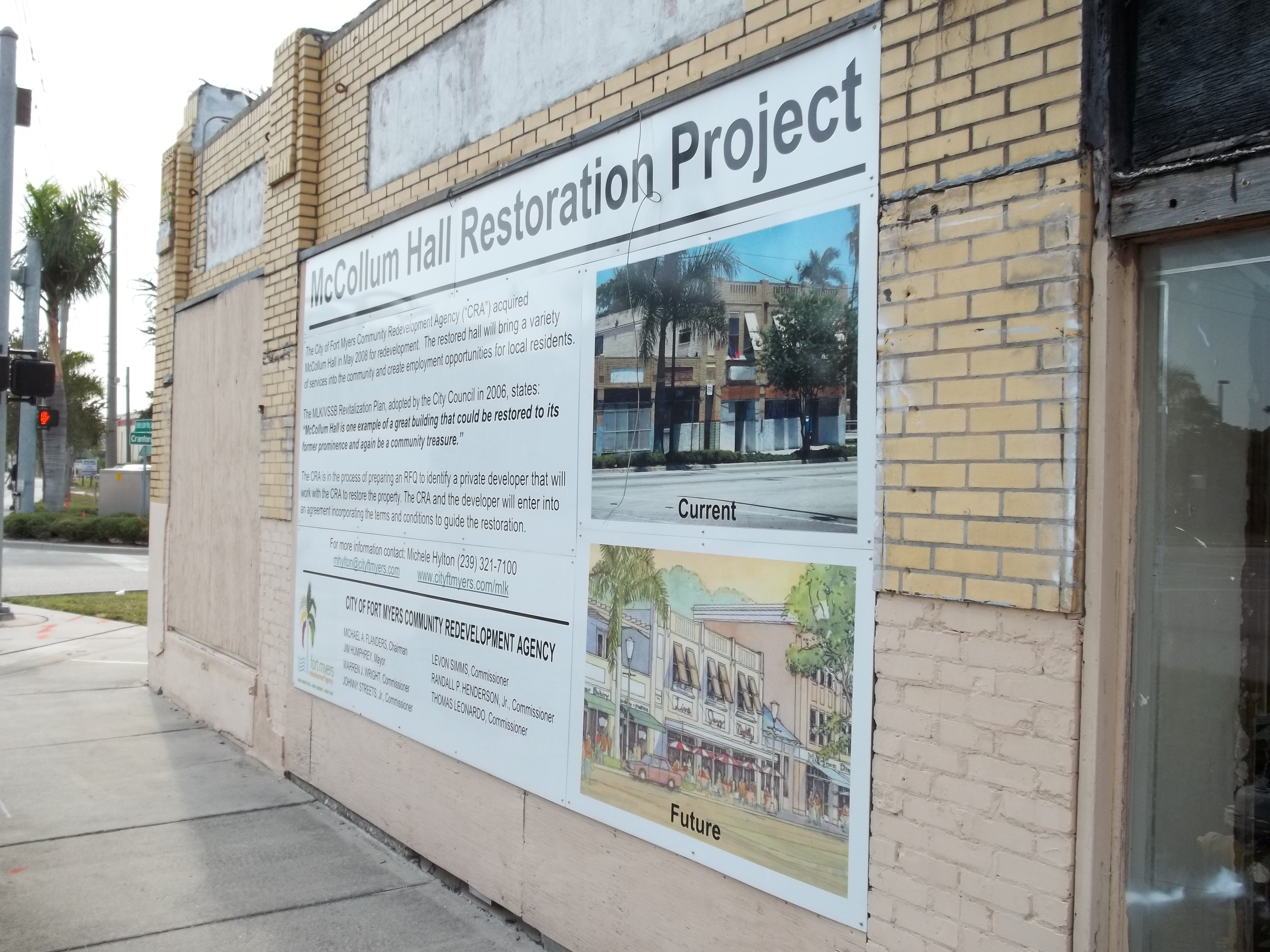
McCollum Hall and the Chitlin' Circuit
In 1938, Clifford 'Buck' McCollum Sr. constructed a two-story building in Dunbar that would become the region's most significant African American entertainment venue. The design was functional and purposeful: the ground floor held Black-owned businesses; the second floor was a dance hall built with the capacity and the acoustics to attract major national talent. McCollum Hall became a documented stop on the Chitlin' Circuit - the network of Black-owned and Black-friendly venues across the South and Midwest where African American performers worked during the segregation era, touring an infrastructure they had built themselves because the white entertainment economy excluded them.
Who Played There
The musicians documented at McCollum Hall form something close to a syllabus of 20th-century American music:
- Duke Ellington
- Ella Fitzgerald
- Louis Armstrong
- Count Basie
- B.B. King
- Dizzy Gillespie
- Otis Redding
During World War II and into the 1950s, the building served a second function alongside the performances: the second floor operated as the USO for Black servicemen stationed in the area, who were barred from using white USO facilities. McCollum Hall held both pleasure and necessity at once, as Black institutions throughout the South did by structural requirement.
Landmark Status and the 2026 Restoration
The City of Fort Myers designated McCollum Hall a local historic landmark in 1998. In 2022, it was added to the National Register of Historic Places - recognition that its significance extends beyond the Dunbar neighborhood and into the national record of African American cultural history. As of 2026, the Fort Myers Community Redevelopment Agency has opened proposals for a restaurant and a music and performing arts center to operate inside the building as part of active restoration work. The hall that hosted Ella Fitzgerald is being returned to life as a working arts venue. That is not a metaphor for continuity; it is a literal reopening.
Williams Academy Black History Museum
Before McCollum Hall was built, before the Chitlin' Circuit ran through Dunbar, there was a school. In the 1912-1913 school year, Williams Academy opened as Lee County's first government-funded school for African American students. Named for J.S. Williams, the county's supervisor of Black schools, it served students from Lee, Charlotte, and the surrounding counties - a regional institution by necessity, because educational options for Black children in Southwest Florida were narrow. The building was a statement of public obligation, however inadequately fulfilled.
By the 1990s the structure faced demolition. In 1994, Janice Cass founded the Lee County Black History Society specifically to prevent that outcome. The Society petitioned the school board, made the case for the building's significance, and won - securing a transfer of the property rather than a wrecking crew. Williams Academy was relocated to Roberto Clemente Park in Fort Myers in 1995. After restoration, it reopened as the Williams Academy Black History Museum in 2001.
The museum holds photographs, documents, artifacts, and oral histories documenting African American life in Southwest Florida from the 19th century forward. For a collector researching provenance connected to the Dunbar community, or a curator building historical context for an exhibition, this is a primary source institution - the kind of place where material exists that hasn't been digitized elsewhere, that doesn't surface in commercial databases, and that changes the frame around a piece of work. Check current hours and access through the museum's official contact before visiting.
Buck's Backyard - A Mural as Collective Memory
Beside McCollum Hall, a 23-panel outdoor mural called 'Buck's Backyard' works as a visual introduction to Dunbar's history for anyone who walks past. The project was a partnership between the City of Fort Myers and the Fort Myers Mural Society, with panels contributed by artists Erik Schlake, J.P. Almonicid, and Roland Ruocco. The scale is substantial; this isn't a commemorative plaque. It's a public art installation that treats street-level viewers as people worth arguing to.
The panels reach beyond portraits of the Chitlin' Circuit performers. Among the subjects depicted:
- The musicians documented at McCollum Hall
- Evelyn Sams Canady, educator and founder of the Dunbar Easter Parade
- Community figures from across Dunbar's history
- Paul Laurence Dunbar, the poet for whom the neighborhood was named
The inclusion of Evelyn Sams Canady alongside the jazz greats is a deliberate choice. It says that cultural memory includes the people who organized community life - not only the performers who came through. Canady built a civic tradition that ran for decades. The mural makes the argument that Dunbar's history is musical, educational, literary, and civic at the same time, and it makes that argument in a format with no admission fee and no gallery hours.
The arc from Williams Academy's 1912 schoolroom to Sonia Louise Davis's 2025 installation at the Baker Museum is not a story of recovery. It is a record of continuous cultural production that the broader art world is only beginning to map with any seriousness.
Sonia Louise Davis at the Baker Museum
In November 2025, Artis-Naples opened a solo exhibition by Sonia Louise Davis at The Baker Museum titled 'to reverberate tenderly,' on view through May 2026. The show pushed against the conventions of how a museum gallery gets used. It included textile-based soft paintings - works that occupy space differently than stretched canvas - alongside a wall mural integrated with neon elements that changed how the room read as a whole. The show's most distinctive element was a set of custom steel instruments Davis designed and built for the exhibition, which she calls 'sounders' - first performed publicly at the Queens Museum in New York when the show premiered there in 2023-2024, and performed live again at the Baker. Audiences experienced the instruments in performance, not behind glass. The exhibition traveled to the Baker from the Queens Museum, where it was organized by Lindsey Berfond, assistant curator; check artisnaples.org for the Baker's full curatorial credits for this presentation.
A Visual Language Built on Improvisation
Davis works within the lineage of Black feminist abstraction and avant-garde music. She has built a personal visual vocabulary - lines, curves, dots, rings, and dashes - that functions like invented musical notation. This vocabulary doesn't depict sound or illustrate music; it enacts the logic of improvisation on a painted surface, making decisions that can't be fully planned in advance and building meaning through repetition, variation, and departure. Standing in front of her soft paintings, you are reading something that operates between musical score and abstract field.
The connection to McCollum Hall is not literal, but it holds. Davis's work sits in the same African American avant-garde lineage that built the Chitlin' Circuit's musical culture - the tradition that produced the figures in Buck's Backyard. The Baker giving her a full multisensory solo show, with custom instruments, live performance, and a mural-scale installation, was not a token inclusion. It was a curatorial statement about where that lineage belongs in a major regional collection.
Onajide Shabaka and Reginald O'Neal
Shabaka at Wasmer Gallery
In January 2026, FGCU's Wasmer Art Gallery opened 'Becoming Tomorrow's Dream' by Miami-based artist Onajide Shabaka, on view through February 2026. Shabaka pairs historic photographs with clippings of Florida flora to examine family, environment, and social progress from the final years of slavery through the present. The work draws on ethnobotany - the study of how human cultures have understood and used plants - and on collective memory across the African diaspora. The pairing of archival photography with botanical material produces something that's neither purely historical nor purely aesthetic: a study of how a people and a landscape have shaped each other across generations. The Florida setting matters to this work in a specific way, not a generic one.
O'Neal in Florida Contemporary
Reginald O'Neal came to the Baker Museum's 13th Florida Contemporary exhibition (October 2025 - June 2026) as a third-generation resident of Miami's Overtown neighborhood - one of Florida's most historically significant African American communities. His 'Jazz Figurines' series received its first comprehensive museum showing in this context. The work uses figurative painting to examine the dehumanizing systems of commodification that have run through the Black experience in America. The jazz figurine as an object is a loaded thing: a Black musical figure reduced to a mass-produced decorative item, stripped of the cultural force that produced it and sold back as kitsch. O'Neal's paintings open that object up and refuse to let it stay decorative. Placing this work in the Florida Contemporary frame - a survey of living Florida artists - anchors it in the present moment of the state's art scene, not only in its historical record.
Resources for Researchers and Collectors
The research infrastructure around African American art and cultural history in Southwest Florida is more substantial than most visitors know. The gap between what exists and what gets used is wide.
The FGCU Digital Archive
FGCU University Archives and Special Collections has digitized the Lee County Black History Society's collection of photographs, news articles, and school memorabilia, making it freely accessible online. No library card or university affiliation is required. For a collector researching provenance connected to the Dunbar community, or a curator building historical context for an exhibition, this is a direct primary source with material that doesn't appear in commercial databases. In 2022, the FGCU-Lee County Black History Society partnership produced the exhibition 'The Black Experience in Lee County,' displayed in Bradshaw Library on the Fort Myers campus - a demonstration of how archived material translates into public programming when institutions commit to the collaboration.
The Broader Institutional Network
Several other institutions form the ecosystem around this work in the region:
- Lee County Black History Society - founded by Janice Cass in 1994, the organization behind the Williams Academy rescue and ongoing archival and educational work in the region
- Sidney & Berne Davis Art Center - Fort Myers' River District venue running continuous programming in visual art, music, film, and arts education, including work connected to the America 250 national initiative alongside local and regional artists
- Alliance for the Arts - Fort Myers community arts organization presenting exhibitions and programming across a range of local and regional artists
- Bob Rauschenberg Gallery - Florida SouthWestern State College gallery with a programming track record that includes contemporary work from underrepresented communities
Where to Go and What to Look For
The institutions described above form a connectable itinerary for anyone engaging seriously with African American art in Southwest Florida. Use this as a working sequence when planning a visit.
- Start at the Williams Academy Black History Museum at Roberto Clemente Park in Fort Myers. The photographs and documents there establish the historical context that everything else builds on. Check hours before going - the museum operates on a specific schedule.
- Walk or drive to McCollum Hall in the Dunbar neighborhood. Even if interior access is limited during active restoration, the building itself and Buck's Backyard mural are visible from the street. Spend real time with the 23 panels before moving on.
- Search the FGCU digital archive before or during your trip - accessible on any device. It will surface photographs and records connected to places and figures you'll see referenced in the museums and murals, and add depth to what you're looking at.
- Visit Artis-Naples / The Baker Museum in Naples. Check the Baker's current exhibition schedule for work across its modern and contemporary programming. The 13th Florida Contemporary runs through June 2026.
- Check FGCU's Wasmer Art Gallery for current and upcoming programming. The gallery has shown Shabaka and maintains a track record of exhibiting work rooted in the African diaspora - worth tracking semester by semester.
- Include the Sidney & Berne Davis Art Center in Fort Myers' River District. Its combination of visual art, music, and community programming mirrors the model that made McCollum Hall matter, and it regularly presents artists working at the intersection of those traditions.
What to look for across all of these venues: work that treats the African American experience in Florida as a subject in itself, not as context or background for something else. The artists showing in Southwest Florida right now are working at a level that stands alongside any regional contemporary scene in the country. The institutions showing their work are making deliberate choices about what history they want to hold. Pay attention to those choices.
| Venue | Type | Primary Focus | Current Access |
|---|---|---|---|
| McCollum Hall | Historic landmark | Chitlin' Circuit heritage; future performing arts | Exterior and mural open; interior - verify with Fort Myers CRA |
| Williams Academy Black History Museum | Community history museum | African American life in SWFL, 19th century to present | Open to public; confirm hours through official contact |
| The Baker Museum (Artis-Naples) | Major regional museum | Modern and contemporary art; major solo and survey shows | Ticketed; check artisnaples.org for current schedule |
| Wasmer Art Gallery (FGCU) | University gallery | Contemporary exhibitions; underrepresented perspectives | Open during academic year; verify schedule through FGCU |
| Sidney & Berne Davis Art Center | Community arts center | Visual art, music, film, community programming | Open; programming varies - check official schedule |
Frequently Asked Questions
Is McCollum Hall open to the public in 2026?
The building's exterior and the adjacent Buck's Backyard mural are accessible from the street. As of mid-2026, the interior is under active restoration, with the Fort Myers Community Redevelopment Agency soliciting proposals for a restaurant and performing arts tenants. Interior access depends on the current phase of that process - contact the CRA directly for updated status before planning a visit inside the building.
Where is the Williams Academy Black History Museum?
The museum is located at Roberto Clemente Park in Fort Myers. The building was relocated there in 1995 after the Lee County Black History Society secured its transfer from the school board, and it reopened as a museum in 2001. Check the museum's official contact for current hours and any admission details before visiting, as operating hours can vary by season.
How do I access the FGCU digital archive of the Lee County Black History Society collection?
The digitized collection - photographs, news articles, and school memorabilia - is freely available online through FGCU University Archives and Special Collections. No library card or university affiliation is required. Search for the collection through the FGCU library website. It's a practical starting point for collectors and curators researching African American history in Southwest Florida before reaching out to institutions directly.
What was the Chitlin' Circuit and why does it matter to Southwest Florida's art history?
The Chitlin' Circuit was the network of Black-owned and Black-friendly venues where African American performers worked during the era of racial segregation, when white entertainment venues were closed to them. McCollum Hall in Fort Myers was a documented stop on that circuit, hosting musicians including Duke Ellington, Louis Armstrong, Ella Fitzgerald, B.B. King, and Dizzy Gillespie. That history matters to Southwest Florida's visual art story because it establishes the depth and continuity of the African American cultural tradition that today's museum exhibitions draw from - the same lineage, different rooms.
Which current exhibitions in Southwest Florida focus on African American artists?
Reginald O'Neal's 'Jazz Figurines' series is part of the Baker Museum's 13th Florida Contemporary, running through June 2026. Sonia Louise Davis's 'to reverberate tenderly' was at the Baker through May 2026. Onajide Shabaka showed at FGCU's Wasmer Gallery in early 2026. All three institutions program Black artists on a recurring basis - check their current exhibition schedules for what follows these shows.
Are there resources specifically for collectors interested in African American artists connected to Southwest Florida?
The FGCU digital archive of the Lee County Black History Society collection is the most underused starting point - it holds primary source photographs and documents that most collectors don't know exist. The Williams Academy Black History Museum and the Lee County Black History Society hold additional contextual material. For living artists, the Baker Museum, Wasmer Art Gallery, Alliance for the Arts, and Sidney & Berne Davis Art Center are the active institutional platforms - tracking their programming over multiple seasons gives a clearer picture of which artists are building consistent regional presence.