Most visitors to Southwest Florida leave without knowing the region holds the only public Roberto Burle Marx mural in the United States. Many walk past mosaics inside hospital corridors and church naves without registering that a single studio - based in Bonita Springs and rooted in a European craft lineage going back to 1908 - made most of them. And a genuine learning pipeline exists here, from coastal-themed beginner pop-ups to intermediate instruction from a fifth-generation master artisan. The mosaic tradition in this part of Florida runs deeper than the galleries and art fairs that define the visible scene.
What Mosaic Actually Is
The word gets used loosely. A tiled kitchen backsplash shares technique with a museum-quality mosaic, but they are not the same thing. Art mosaic is an image or decorative composition built from individual pieces of material called tesserae - cut and set into adhesive or mortar, then grouted so the lines between pieces become part of the composition rather than an unavoidable seam. The image emerges from the arrangement, color, and surface angle of each piece, and from choices the artist makes about every single one.
Materials
- Vitreous glass - machine-pressed glass tile with consistent thickness and a smooth face; comes in hundreds of colors, resists water and UV exposure, and is the standard choice for pool installations and exterior work
- Smalti - hand-poured Italian glass, opaque with an irregular surface that catches light differently from every angle; the historic material of Byzantine church mosaics and still the benchmark for fine art work
- Ceramic tile - the most accessible material, easily cut with tile nippers or a wet saw, and used across the full range from garden path work to major public murals; the Roberto Burle Marx piece at the Naples Botanical Garden is ceramic tile
- Mirror and reflective glass - used for accent work and residential decorative pieces; creates strong visual movement but tends to overpower a composition unless used with discipline
Mosaic Versus Stained Glass and Fused Glass
The confusion between mosaic and stained glass is common and understandable - both appear prominently in religious architecture and both work with colored glass. The difference is structural. Stained glass is a window: individual pieces of colored glass are joined by lead channels into a panel designed to transmit light from behind. Remove the backlighting and the image largely disappears. Mosaic is a surface art that reflects ambient light from the front. It can go on any wall, floor, or substrate regardless of whether natural light is available.
Fused glass is different still - it involves melting pieces together in a kiln until they bond into a single object. A fused panel is one unified sheet; a mosaic is always an assembly of many separate pieces held together by grout and adhesive. That distinction matters practically: a damaged tessera in a mosaic can be replaced individually, while fused work usually cannot be partially repaired.
Southwest Florida's institutional buildings take to mosaic for practical reasons that have nothing to do with fashion. Properly installed mosaic is genuinely permanent - floors from ancient Rome are still intact. It requires no electricity, no UV films, no climate-controlled storage. For a hospital corridor or a church that expects to outlast its donors, that permanence is exactly the point.
Apperlo Art: The Studio Behind Most of the Region's Major Commissions
If you have spent time in Southwest Florida's institutional buildings and encountered a glass mosaic, there is a reasonable chance it came from Apperlo Art in Bonita Springs. The studio is run by Mila Apperlo and Stevan Stanisic, and it sits at the intersection of two distinct artistic backgrounds.
A European Craft Lineage
Stanisic is a fifth-generation master stained glass artisan. His great-great-grandfather founded the Vitraux Art Studio in Hungary in 1908, and the knowledge of working with art glass - its chemistry, its behavior in different light, the craft mechanics of cutting and setting - has passed through every generation since. That depth of formation is uncommon in the United States, where most glass art instruction is self-taught or drawn from short workshops. Stanisic brings fluency with the material that typically takes decades to develop.
Mila Apperlo works independently as an abstract painter, blending mixed media and intuitive technique with her glass background. Her paintings are shown at the Naples Art District and through the Alliance for the Arts in Fort Myers. The combination of a painter's compositional eye and a craftsman's material knowledge shapes how Apperlo Art approaches major commissions differently from a purely technical fabrication studio.
The Range of Work
- Healthcare: nine glass mosaics for Lee Memorial Hospital in Fort Myers - one for each floor - using more than 25,000 individual pieces of hand-cut colored glass across a nine-month production period
- Religious: six Creation mosaics for Trinity-by-the-Cove Episcopal Church in Naples, each panel representing one day of Genesis, commissioned at the direction of Reverend Edward Gleason
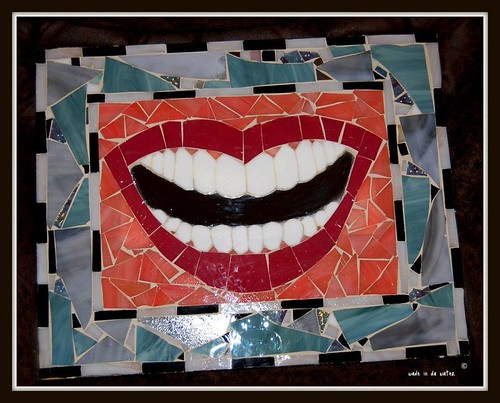
- Commercial: a large-format glass mosaic for Cape Dental Care in Cape Coral depicting the Sanibel Causeway, lighthouse, dolphins, pelicans, tropical flowers, and coastal wildlife, handcrafted from tens of thousands of individual pieces
- Residential: swimming pool mosaics, lanai installations, entryway features, and kitchen backsplashes for private clients across the region
Public Mosaics Worth Visiting
Most of the significant installed mosaic art in the region is accessible without an appointment, though several pieces require entering a building during operating hours.
The Apperlo Art commissions at Lee Memorial Hospital and Trinity-by-the-Cove Episcopal Church are both open to visitors - the hospital during standard hours, the church during visiting hours. Seeing either in its actual setting adds something no materials list conveys. The hospital installation functions partly as wayfinding and partly as environmental art; the church panels, set along the walls of the church's exterior East Courtyard and read in reflected ambient light, make an argument for the medium that reproductions cannot.
At Naples City Hall, a large-scale photo-mosaic titled Naples Pier by Emillions Art is permanently installed on the first floor. The photo-mosaic format uses thousands of photographs as its tiles rather than cut glass or ceramic tesserae - it is a different medium from the traditional tessera mosaics discussed elsewhere in this guide, though it shares the mosaic principle of an image built from many smaller units. The subject - a landmark that has been painted and photographed thousands of times - connects to the long record of artists returning to this particular image across different media.
The Roberto Burle Marx Mural at the Naples Botanical Garden
The Naples Botanical Garden holds the only public Roberto Burle Marx mural in the United States - a ceramic tile work Burle Marx created himself in the early 1990s, installed in the Brazilian Garden he helped inspire. Almost no regional arts coverage has caught it.
Burle Marx is one of the most important landscape architects and visual artists of the twentieth century. Most people outside Brazil know his work through one image: the wave-patterned black-and-white mosaic sidewalk along Copacabana Beach in Rio de Janeiro, a design so widely reproduced that it has become a visual shorthand for Rio itself. The Naples piece connects directly to that tradition - ceramic tile mosaic by the same hand, in the same medium. The Copacabana promenade dates to 1970; the Naples mural to 1991, part of the same long practice that defined the final decades of his working life.
The mural was donated to the garden by Raymond Jungles, a landscape architect who trained under Burle Marx and who also designed the Brazilian Garden that surrounds the piece. That context matters. The mural should be understood alongside the planting: Jungles built the garden as a tribute to Burle Marx's approach to tropical landscape and the relationship between art and natural form. Seeing the mural in isolation misses half of what makes the visit worthwhile.
Why does this go almost entirely uncovered in regional arts journalism? Burle Marx is not a name that circulates in Southwest Florida media. The Botanical Garden is covered as a horticultural destination, not an art destination. And the piece sits inside a thematic garden section rather than in a gallery context that would trigger art coverage. The result is a verified one-of-a-kind American artwork that receives less attention than many temporary exhibitions at local galleries.
Learning Mosaic in Southwest Florida
Three distinct entry points cover the full range from complete beginner to intermediate student, which is more structured than most regional markets offer.
| Venue | Format | Level | Season |
|---|---|---|---|
| Beach Life Mosaics | Pop-up workshops at rotating venues in Bonita Springs and Naples | Beginner; all materials included | Throughout the season; check current listings |
| Naples Glassworks | Studio classes; beginner mosaic always available alongside glass work | Beginner to developing student | October through May |
| Centers for the Arts Bonita Springs | Structured Intermediate Mosaics course | Intermediate | Scheduled sessions; verify with Centers |
Beach Life Mosaics runs pop-up workshops with designs drawn from coastal imagery - seahorses, sea turtles, sand dollars, starfish, flamingos. The pop-up format eliminates studio overhead for the student: you arrive, work, and leave with a finished piece. All materials are included. Check current listings for project options and fees, as the menu rotates through the season.
Naples Glassworks is run by Judy Belmont, whose background before glass art was as a mental health author and retired psychotherapist. That combination of patient-focused thinking and visual instruction shows in how the studio approaches newcomers. Beginner mosaic projects are always available alongside the stained glass and fused glass programming. Classes run October through May; check the studio's current schedule for available sessions and fees.
For students who have moved past beginner work and want to develop real technique, Stevan Stanisic teaches Intermediate Mosaics at the Centers for the Arts Bonita Springs. Mila Apperlo also co-teaches stained glass and mosaic workshop sessions there. Learning intermediate mosaic from a fifth-generation master artisan at a regional arts center is not a typical offering - this is the kind of instruction more commonly found in a European craft school. Contact the Centers for current enrollment and scheduling.
How Commissioning a Mosaic Works
A serious commission is not an off-the-shelf transaction. Clients who understand the sequence upfront tend to get better results and more accurate expectations on timeline and cost.
- Design consultation - The artist reviews the installation space, discusses visual goals, and proposes a concept. Complex pieces often involve renderings or material samples before production begins.
- Material selection - Vitreous glass, smalti, ceramic, or a combination are chosen based on location (interior or exterior, wet or dry, sun exposure) and the desired visual effect. Pool and outdoor installations require materials rated for UV and water exposure.
- Production - The longest phase. The Lee Memorial Hospital commission - more than 25,000 individual hand-cut pieces - took nine months. Residential pieces are smaller, but hand-cutting takes time regardless of scale. A complex mosaic is not a six-week project.
- Substrate preparation - The wall, floor, or surface must be properly prepared before any tesserae are set. Poor substrate is the primary cause of mosaic failure over time. A good studio will specify what is required and inspect the surface before proceeding.
- Installation and grouting - Grout color is a significant design decision, not a finishing detail. A dark grout reads differently from a light one across the same mosaic, and this choice should be made during design review, not at the end.
- Sealing - Exterior and wet-area installations require sealing. Interior dry-area work may not, but the studio should advise based on the specific context.
Residential clients most commonly commission pool mosaics, entryway installations, kitchen backsplashes with custom imagery, and lanai accent walls - spaces that benefit from both the permanence and the water-resistance of the medium. Apperlo Art handles all of these alongside its institutional and religious work.
Mosaic Within the Broader Glass Art Scene
Southwest Florida has an established glass art community covering stained glass, fused glass, and kiln work alongside mosaic. Several artists work across more than one discipline. Apperlo Art bridges both within a single practice: Stanisic's family lineage is stained glass; the studio's major institutional commissions are mosaic. That practical boundary - where a hospital corridor or church wall under variable lighting requires mosaic because the conditions rule out transmitted-light media - is where the two traditions diverge in ways that matter for serious commissions.
Buying Finished Mosaic Work
The commission model dominates the region's mosaic output; most significant work here was made for a specific location. Finished mosaic art is available, but through narrower channels than painting or photography.
- Mila Apperlo's independent abstract paintings - which draw on her glass background through mixed media and intuitive technique - are shown at the Naples Art District and through the Alliance for the Arts in Fort Myers
- Pop-up workshop venues occasionally show finished work by instructors alongside class materials
- Regional winter art fairs in Naples sometimes include mosaic artists with completed panels and objects
- Direct contact with Apperlo Art will clarify what, if anything, is available outside active commissions
Collectors should know that mosaic as a collected object creates handling challenges that most galleries are not set up for. Weight and fragility make shipping difficult. Buying directly from a studio, with the artist advising on transport and installation, is the more reliable path for any significant piece.
Frequently Asked Questions
Where exactly is the Roberto Burle Marx mural in Naples?
In the Brazilian Garden section of the Naples Botanical Garden, donated by landscape architect Raymond Jungles, who also designed the surrounding garden. Check the garden's website for current hours and admission before making a dedicated trip to see the piece.
How is mosaic different from stained glass?
Stained glass is a window that transmits light from behind - the image largely disappears without backlighting. Mosaic reflects ambient light from the front and works on any surface without natural light. Both use colored glass; the structural logic is completely different.
Can Apperlo Art commission a mosaic for a residential pool?
Yes - swimming pool mosaics are among the most common residential commissions in the region and Apperlo Art handles them alongside institutional and religious projects. The key material requirement is vitreous glass rated for water and UV exposure. Timeline and cost vary by complexity and scale; contact the studio directly for a consultation.
Where can a complete beginner try mosaic without committing to a course?
Beach Life Mosaics runs pop-up workshops throughout the season at venues in Bonita Springs and Naples with all materials included and no prior experience required. Naples Glassworks also keeps beginner mosaic projects available through its October-to-May program. Neither requires more than a single-session commitment.
Is the Apperlo Art studio open to visit?
Apperlo Art is a working production studio rather than a public gallery, and the best approach is direct contact to discuss a commission or inquiry. The studio's work is on permanent public view at Lee Memorial Hospital, Trinity-by-the-Cove Episcopal Church, and other locations across Lee and Collier counties.
Why do churches and hospitals commission mosaics rather than paintings or prints?
Mosaic does not fade, peel, or require climate control - properly installed, it can outlast the building's other contents by centuries. Hospitals value the visual complexity for its documented effect on patient stress. Churches value both the permanence and the continuity with early Christian and Byzantine sacred art traditions.