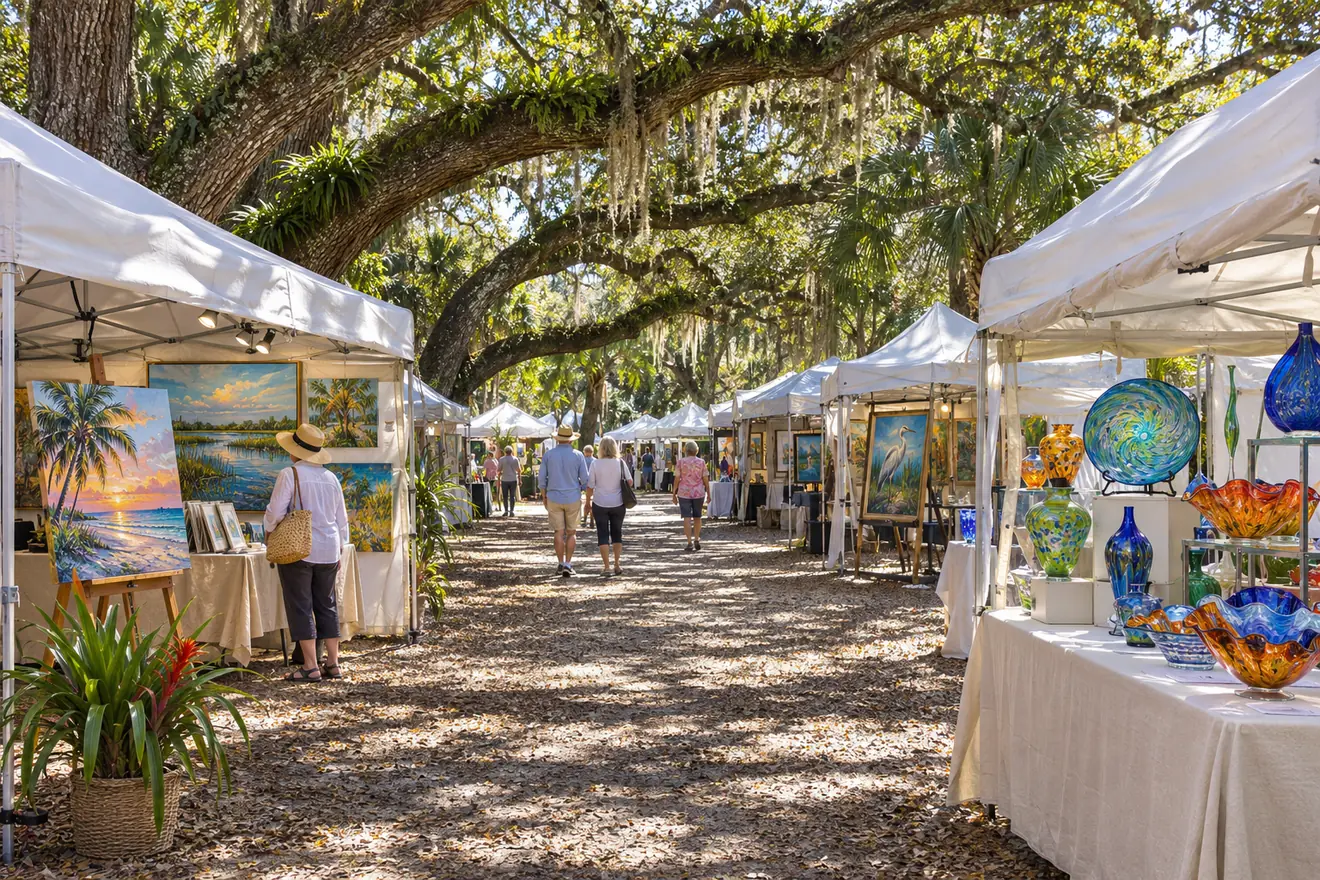
Art festivals in Southwest Florida are outdoor weekend sales in which artists sell their own work from white tents in parks, on closed streets and in mall lots, mostly from January through March. Some are juried fine art shows, some are mixed art and craft fairs, and some are local community markets, so the label "art festival" alone does not tell you the quality or the price level.
From January through March the region's parks, closed streets and mall lots fill with white tents. Festivals are the most visible face of art in Southwest Florida and the most misunderstood, both by visitors buying and by artists selling. For dated, recurring events in galleries and studios rather than tents, see the guide to art walks and studio nights in Southwest Florida.
The three tiers of art festivals and art shows
- Juried fine art festivals: exhibitors screened by a panel, national touring artists alongside strong locals, higher price points, no buy-sell resale work permitted.
- Art and craft festivals: mixed juried and open, wide quality range, accessible prices, family atmosphere.
- Community and market events: largely local hobbyists and makers, small work, very low prices.
All three call themselves art festivals. Knowing which one you are walking into sets the right expectation.
What "juried" means
In a juried festival, artists submit images of their work and a jury fee to the organizer, and a panel decides who is admitted. The point is quality control: the screening is meant to keep out resale goods and keep the standard of work consistent from booth to booth. When a festival's website does not say how exhibitors are chosen, treat it as an open or mixed event until you see otherwise.
How to tell which tier an event is
- Check the organizer's page for the words "juried", "jury fee" or "application deadline"; a show that screens exhibitors is likely to say so.
- Look for a rule against resale or imported goods; fine art shows tend to state it.
- Compare the typical work shown in the organizer's photos: original paintings and sculpture at larger sizes point to a fine art show, while many small items and crafts point to the lower tiers.
Art festivals for buyers
Walk the entire field before buying anything; the booth that impresses you at the entrance is rarely the best one there. Ask directly whether a piece is an original or a reproduction, and expect a print to be priced at a fraction of an original. Ask where the artist works and how the piece was made; anyone dodging that question is telling you something. Prices at festivals are usually firm on the first day and softer on the last afternoon, when packing up is the alternative.
For what to look for in an original work, and how to keep a record of the purchase, read the guide to collecting original art in the region. If you would rather see finished work in a gallery setting, the Naples gallery guide and the Fort Myers gallery guide cover the permanent venues.
Art festivals for exhibiting artists
Budget for a jury fee plus a booth fee, and expect no commission taken on sales. You need a professional canopy rated for wind, weights on every leg, walls, lighting, a card reader, change and a plan for rain. Sales cluster in small and mid size work. A weekend is two very long days of standing, and the artists who do well treat the booth as a shop rather than a gallery.
Checklist before you apply
- Read the prospectus for the jury fee, the booth fee, the booth size and the rules on what may be sold.
- Prepare consistent, well-lit images of the work, since the application is judged from images.
- Price a range, including small work, because sales cluster in small and mid size pieces.
- Plan the booth for wind and rain before the first show, not after it.
The guide for artists working in the region covers the local scene beyond festivals, and the art leagues and community art centers are a common starting point for local artists who want to show work before entering juried events.
Festival season and weather in Southwest Florida
Peak festival weekends run late January through early March, when the visitor population is highest. Cold fronts and coastal wind are the real hazards; a poorly weighted tent becomes a sail. Summer outdoor festivals essentially do not exist here, for good reason. To plan a trip around these weeks, see the season guide to timing your visit.
Dates and locations are set each year by individual organizers and are sometimes moved or cancelled for weather, so confirm the weekend, hours and admission on the festival's own page before you travel.
Practical advice for visiting
- Arrive early for parking and for the best selection.
- Bring cash for small purchases, though nearly everyone takes cards.
- Ask about shipping before buying something large.
- Take a card and a photo rather than deciding on the spot if you are unsure.
Frequently Asked Questions
When are the art festivals in Southwest Florida?
Most take place from January through March, with peak weekends from late January through early March when the visitor population is highest. Summer outdoor festivals essentially do not exist in the region. Exact dates are set by each organizer, so check the event's own page for the current year.
What is a juried art festival?
It is a festival where a panel screens artists' applications before admitting them. Juried fine art festivals bring national touring artists alongside strong local ones, charge higher prices and do not permit buy-sell resale work.
Are art festivals in Southwest Florida free to attend?
Admission differs by event, and some are held in public parks or on closed streets. Check the organizer's page for admission and parking before you go, and bring some cash for small purchases even though nearly every artist takes cards.
Can I negotiate prices at an art festival?
Often only a little. Prices are usually firm on the first day and softer on the last afternoon, when packing up is the alternative for the artist.
What does it cost an artist to exhibit?
Expect a jury fee plus a booth fee, and no commission taken on sales. The amounts vary by festival, so read each prospectus, and add the cost of a wind-rated canopy, weights, walls, lighting and a card reader.