Encaustic painting is not a casual curiosity in Southwest Florida. It has an organization, a home venue, working artists who built studios around the medium, and a teaching infrastructure spread across three counties. The work looks unlike anything produced in oil or acrylic - wax surfaces that hold light from within, layers that read as genuine depth, textures that no brush dragged across canvas can replicate. This guide covers the medium, the history behind it, the local scene built around it, and what you need to know if you plan to collect it.
What Encaustic Is: The Medium, the Tools, the Look
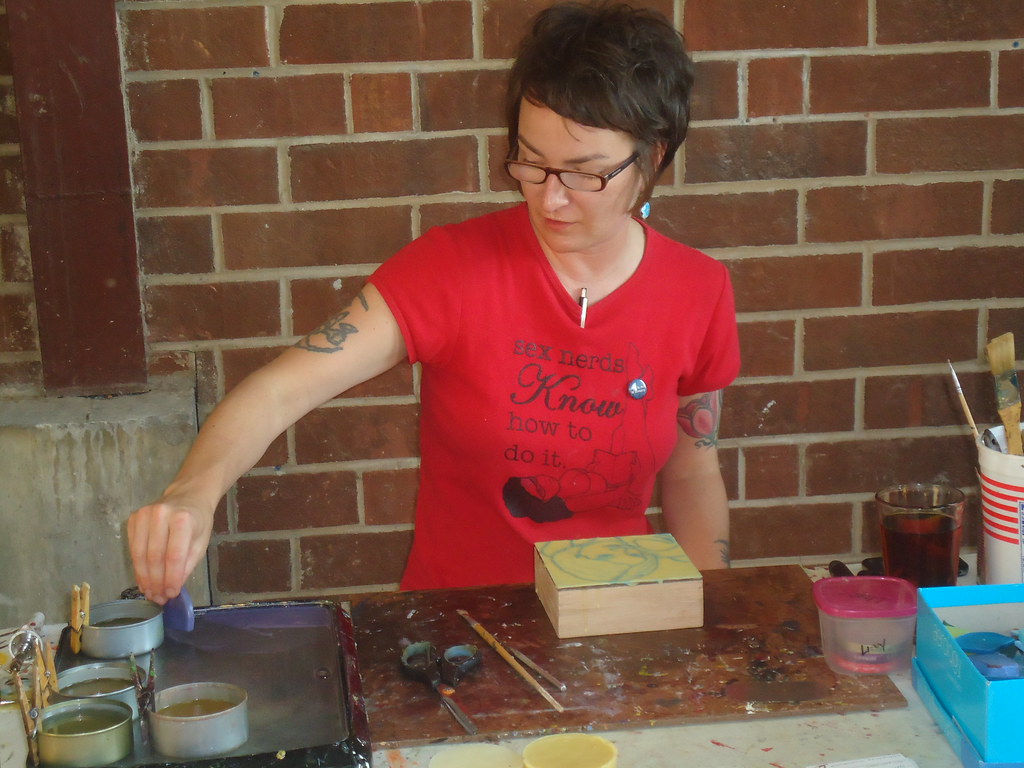
The word comes from the Greek enkaustikos, meaning burnt in. That etymology is the explanation. Encaustic painting requires heat at every stage of making. The medium - beeswax combined with damar resin - is kept molten on a heated palette. The artist applies it to a rigid surface, typically cradled wood panel, then fuses each layer with a heat gun or torch before adding the next. That fusing step is not optional: without it, layers do not bond to each other or to the substrate, and the painting fails structurally.
What heat makes possible is a surface unlike any other. Light enters translucent wax and reflects back from within, giving even flat areas a luminous quality that deepens as more layers accumulate. Earlier stages remain visible through those above them, creating genuine visual depth. The surface can also be carved, incised, or used to embed materials - paper, metal leaf, fiber, drawn marks - sealed inside the wax permanently.
What You Need to Work in Encaustic
- A heated palette or griddle to keep the medium liquid during painting
- A heat gun or butane torch for fusing between each applied layer
- A rigid surface - encaustic cracks on flexible supports, so canvas is not viable
- Natural-bristle brushes or metal tools for application and surface manipulation
The damar resin in the medium is a natural sap from Dipterocarpaceae trees in East Asia. It raises the melting temperature of the beeswax and significantly increases the hardness and durability of the finished work. Beeswax alone is soft; the resin makes the cured medium harder and more resistant to damage. Artists adjust how much resin they use depending on the working properties they want - any workshop taught by a practicing artist will cover this hands-on, which is the right place to understand it.
A Very Old Technique: From Fayum to Rivera to the Present
The oldest surviving encaustic works are the Fayum mummy portraits, painted by Greek settlers in Roman-era Egypt between roughly 100 and 300 AD. Around 900 of these portraits are known today, most unearthed from the Necropoleis of the Fayum region of Egypt. They were placed over the faces of mummies in lieu of the traditional mask - small, direct, startlingly lifelike portraits of individuals. What distinguishes them to a modern eye is the color, which has largely not faded. The encaustic medium carried that pigment intact for nearly two millennia, and the portraits remain on display in museums today.
When the Roman Empire fell, encaustic fell with it. The technique did not gradually simplify or migrate into related forms - it disappeared from practice almost entirely and stayed gone through the medieval period and the Renaissance. Diego Rivera, the Mexican muralist, engaged with encaustic in the 1920s as part of his exploration of classical painting methods. That engagement brought the medium back into the conversation among modern artists. The broader contemporary revival expanded through studio networks, international workshops, and organizations like the International Encaustic Artists, which now connects practitioners globally. Most of the technique literature, workshops, and regional communities available today are products of the last few decades.
Hot Wax and Cold Wax: Two Distinct Practices
Gallery labels and casual conversation often group hot wax and cold wax together. They are chemically distinct media, and the distinction matters both to artists choosing a direction and to collectors understanding what they are buying.
| Factor | Encaustic (Hot Wax) | Cold Wax |
|---|---|---|
| Base medium | Beeswax and damar resin, kept molten | Wax paste mixed into oil paint |
| Heat required | Yes - essential at every stage | No - should never be heated |
| How it cures | Solidifies on cooling; layers fused by heat | Cures through solvent evaporation and oxidation |
| Surface finish | Glossy and luminous, can be buffed | Matte and velvety |
| Heat sensitivity when finished | Higher - can soften under sustained heat | Lower - oil paint base is more stable |
Cold wax is a paste worked directly into oil paint to change its body, transparency, and drying characteristics. It produces a textured, matte surface that carries some of the layered quality of encaustic without the thermal requirements. It is a fully independent medium, not an approximation of encaustic. Artists like Madeline Sugerman on Marco Island work in both, treating them as related but separate vocabularies that suit different intentions.
SWFL WAX: How the Regional Organization Was Founded
The absence of encaustic awareness in Southwest Florida was the founding problem. Artists Madeline Sugerman and Sherry DeGennaro met at the Santa Fe Art Expo, discovered they both practiced encaustic, and recognized that the medium had no real community or visibility back on the Gulf Coast. They founded SWFL WAX in 2018.
SWFL WAX is the Southwest Florida chapter of International Encaustic Artists (IEA), a global membership organization for practitioners of the medium. The IEA affiliation gives local members access to a broader network of artists, resources, and publications, while the regional chapter focuses specifically on building presence in Collier and Lee counties. The organization's home base is Naples Art - the Naples Art Association on Fifth Avenue South - which hosts the group's monthly meetings, workshops, and exhibition programming.
What the organization does in practice:
- Monthly meetings open to members, with live demonstrations by working artists
- Structured critique sessions for works in progress
- Technique-focused skills workshops for members at all experience levels
- Public exhibitions that bring encaustic to gallery visitors unfamiliar with the medium
- Connection to the International Encaustic Artists network for members seeking broader reach
The founding story - two artists meeting at an out-of-state expo and returning to build something locally - reflects how regional art communities often start: through individual initiative rather than institutional planning.
Artists Working in the Medium Locally
Madeline Sugerman
Co-president of SWFL WAX, Sugerman operates a fine art gallery and working studio on Marco Island focused on encaustic, cold wax, and mixed-media oil work. A gallery that is also a working studio is unusual - visitors can see not just finished panels but the tools and process that produced them. Her practice across three related media reflects the way encaustic often functions in a working artist's output: as one element in a material vocabulary rather than a strict specialty.
Sherry DeGennaro
Also co-president, DeGennaro is the region's most active encaustic instructor. She teaches at Naples Art, Bonita Springs Center for the Arts, and Marco Island Art Center - covering all three primary teaching venues in the area - and also instructs at Layor Art Gallery in Bend, Oregon, situating her practice in a national context. Her work building SWFL WAX's teaching infrastructure is what made the regional community functional rather than aspirational.
The SWFL WAX roster extends beyond the two co-presidents. Monthly sessions draw artists from across both counties, working across the range of encaustic approaches - from structured, architecturally precise compositions to organic abstractions that exploit the medium's tendency to pool, spread, and move unpredictably as it cools.
Where to See Encaustic Work in Southwest Florida
- Naples Art, Fifth Avenue South - The primary venue for SWFL WAX exhibitions and the organization's official home base. The association's calendar carries encaustic shows alongside monthly programming.
- Madeline Sugerman's gallery and studio, Marco Island - A working space where encaustic and cold wax pieces are on view alongside the process that produced them.
- Marco Island Center for the Arts - Has featured encaustic work in juried group exhibitions, including shows connected to regional chapters of national women's art organizations whose members work in the medium.
Encaustic does not circulate widely through the region's general commercial gallery scene. It appears most reliably through SWFL WAX's own programming and in juried group exhibitions at these three venues. Following the organization directly - through Naples Art's calendar and IEA member communications - is the most dependable way to track what is on view.
Where to Learn: Classes and Workshops
Encaustic is a medium that requires direct instruction. Reading about fusing is poor preparation for doing it - correct temperature, the feel of proper fusion, and the behavior of the medium at different heat levels are learned in a studio with a heat source in hand. Three venues in the region offer that instruction, with Sherry DeGennaro teaching at all three.
A first encaustic workshop typically follows this sequence:
- Introduction to the heated palette: maintaining working temperature and reading how the medium behaves at different heat levels
- Surface preparation: why rigid panels are required and how to prime them for wax adhesion
- First layer application: loading a brush, achieving even coverage, and getting comfortable working with hot material
- Fusing: using a heat gun or torch to bond the first layer, and learning to read the surface for correct fusion
- Building additional layers: translucent over opaque, light over dark, and how sequential layering produces depth
- Finishing: buffing the cooled surface, addressing surface irregularities, and receiving care instructions for the finished panel
Workshop formats vary between Naples Art, Bonita Springs Center for the Arts, and Marco Island Art Center - some cover foundational technique for beginners, others address specific processes like collage integration, transfer printing, or incised surface work. SWFL WAX's monthly sessions at Naples Art offer a complementary route: members at all skill levels attend together, and the open work and critique format gives newer artists direct contact with more experienced practitioners.
Collecting Encaustic Art: What Buyers Need to Know
Bloom Is Normal
A white hazy film called bloom can develop on encaustic surfaces during the first year as the wax cures. This is not damage. It clears completely with gentle buffing using a soft, lint-free cloth - no products, no moisture, no commercial cleaners. Most artists will explain this before a sale. If they do not, ask. A panel that clouds slightly in its first months has not been harmed.
Heat Is the Collector's Main Concern
Finished wax works must be stored and shipped away from direct heat sources. Unlike oil or acrylic, encaustic panels can take impressions if exposed to sustained heat. For shipping or transport, climate-controlled conditions are necessary - standard courier vehicles in summer are not appropriate. Collectors who purchase directly at local shows and carry work home immediately take the safest route.
Questions worth asking before purchasing:
- Is the surface bare wax, or has it been varnished? This affects how bloom develops and how the surface should be cleaned.
- What rigid substrate is the panel built on, and how is it backed or framed?
- What does the artist recommend for cleaning? Commercial glass and surface cleaners are not appropriate for wax.
- Has the work been stored consistently since completion, away from heat sources?
Why This Medium and Why Southwest Florida
The light along the Gulf Coast in winter and spring is flat, bright, and pervasive. It does not rake - it fills. What encaustic does in that kind of light is reveal interior depth. The translucent layers catch ambient brightness and hold it, rather than reflecting it off a painted surface. Collectors who see encaustic work for the first time in a well-lit gallery often stop at it in a way they do not stop at oil paintings. That response is partly what the medium offers specifically in this region's light.
There is a useful thermal quality to the climate as well. Encaustic requires warmth to work; a studio that is already warm reduces the energy needed to keep a working palette at temperature. The subtropical environment is, in a practical way, compatible with the process.
The same warmth that helps in the studio is a hazard to the finished work - and navigating that tension is what made a formal organization, rather than informal awareness, necessary here.
The founders of SWFL WAX recognized in 2018 that the Gulf Coast climate demanded that collectors be properly educated, that exhibitions be contextualized, and that teaching be available through multiple accessible venues. Building that infrastructure around a single medium, in a region with no prior encaustic community, produced something specific: a local art scene that is genuinely coherent around a difficult and ancient practice.
Frequently Asked Questions
What is the difference between encaustic and oil painting?
Encaustic uses pigmented beeswax as its medium rather than oil. The wax is applied hot and fused with heat between every layer, which is fundamentally different from how oil paint is built up and dried. The finished surface is wax - not a dried film of oxidized oil - which gives it different optical properties, different care requirements, and a completely different working process.
Can I hang encaustic art in a sunroom or near a south-facing window?
Sustained direct heat is the risk, not light alone. A sunroom that reaches high temperatures on summer afternoons, or a wall that receives direct midday sun through glass, could soften the wax surface over time. Indirect natural light in a climate-controlled interior is fine. In Southwest Florida, any unventilated space - a sunroom without AC, a garage, a car - should be avoided entirely for storage or display.
Does encaustic art need glass when framed?
Most encaustic panels are displayed without glass, since the wax surface is itself the finish and covering it would interfere with its visual quality. Framing, if used, should not press against the wax surface. Many artists finish panels with a painted or waxed edge and hang them unframed - ask the artist what approach suits their specific work before commissioning any framing.
How do I find SWFL WAX exhibitions and current class schedules?
The most reliable route is through Naples Art's calendar - the Naples Art Association on Fifth Avenue South hosts SWFL WAX's monthly meetings and exhibition programming. Class schedules at Bonita Springs Center for the Arts and Marco Island Art Center change seasonally, so checking those venues directly is the best approach for current workshop offerings.
Is encaustic harder to learn than other painting media?
Different rather than simply harder. The thermal element requires attention that oil painting does not, and the rigid panel changes the physical relationship to the surface. First sessions typically produce results quickly because the medium allows reworking - you can fuse, scrape back, and rebuild - which is genuinely forgiving for beginners. Developing judgment about heat and layering takes time, but the initial barrier is lower than many people expect.
What should I do if my encaustic piece develops a white film?
This is bloom, a normal part of the wax curing process during the first year. Buff the surface gently with a soft, lint-free cloth - no products, no moisture. The film will clear and should not return. If the surface has other irregularities beyond a hazy film, contact the artist directly before attempting any cleaning.