Printmaking has never quite fit the Southwest Florida art narrative. Galleries here sell plenty of oil seascapes and watercolor sunsets, and collectors spend serious money on them. But original prints - works pulled from a matrix the artist made by hand - occupy a different position in the regional art economy, and a surprisingly strong one. The Baker Museum holds etchings by Rembrandt and prints by Matisse, Rauschenberg, and Kandinsky. A Naples gallery carries documented prints by Warhol, Picasso, and Miró. Fort Myers has hosted a dedicated juried printmaking exhibit drawing artists from across the region. Florida Gulf Coast University runs a three-course printmaking sequence. The medium is here, working at every level from student studio to museum collection - it just hasn't been written about as a coherent scene until now.
The Three Types of 'Print': A Collector's Vocabulary
Nothing causes more confusion in the Southwest Florida art market than the word "print." It covers three fundamentally different things, and sellers don't always make the distinction clear. Understanding each category before you buy protects both your money and your wall.
A reproduction is a photomechanical copy of an existing painting or drawing - a poster, open edition and unlimited. The artist had no hand in making it beyond creating the original work. Reproductions are decorative objects; they are not collectible investments.
A giclée is an archival inkjet print produced from a high-resolution digital file. When limited, numbered, and signed by the artist, a giclée occupies a legitimate mid-market tier, and many living artists use the format to make their work accessible. But no matrix was made, no physical pressing of ink to paper through an artist-made surface. In Southwest Florida galleries, giclées are sometimes marketed with language that implies parity with original prints; the collecting history and value retention don't match up.
An original fine art print is what this guide covers. The artist creates a matrix - a carved woodblock, an etched copper plate, a prepared lithographic stone, a silk screen - and pulls impressions from it by hand. The matrix and the printing process are the art, not a copy of something else.
| Type | Matrix | Edition | Collectible status |
|---|---|---|---|
| Reproduction | None | Unlimited, open | Decorative only |
| Giclée | Digital file | Often limited and signed | Mid-market, moderate |
| Original fine art print | Physical - carved, etched, drawn | Fixed, hand-printed | Strongest collecting history |
The Techniques: What Is Being Made and How to Identify It
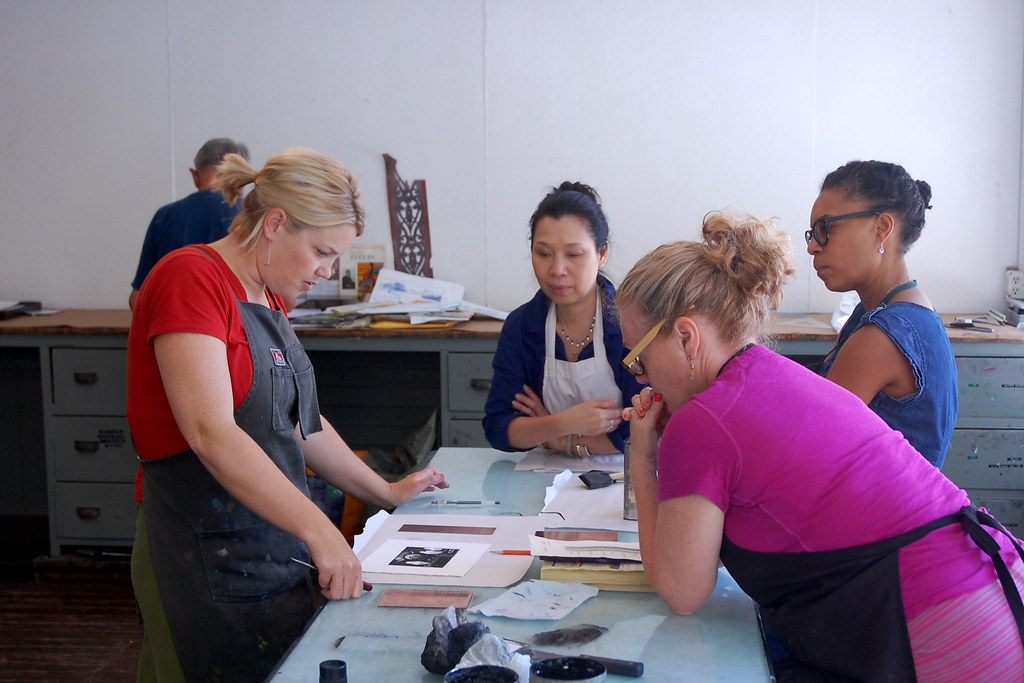
Printmaking is not a single medium - it is a family of related processes. The Alliance for the Arts juried exhibit in Fort Myers has drawn entries across monotype, etching, woodcut, linocut, and lithograph. FGCU teaches relief, intaglio, collagraph, and monoprint. Here is what each category means and how to recognize it on the wall.
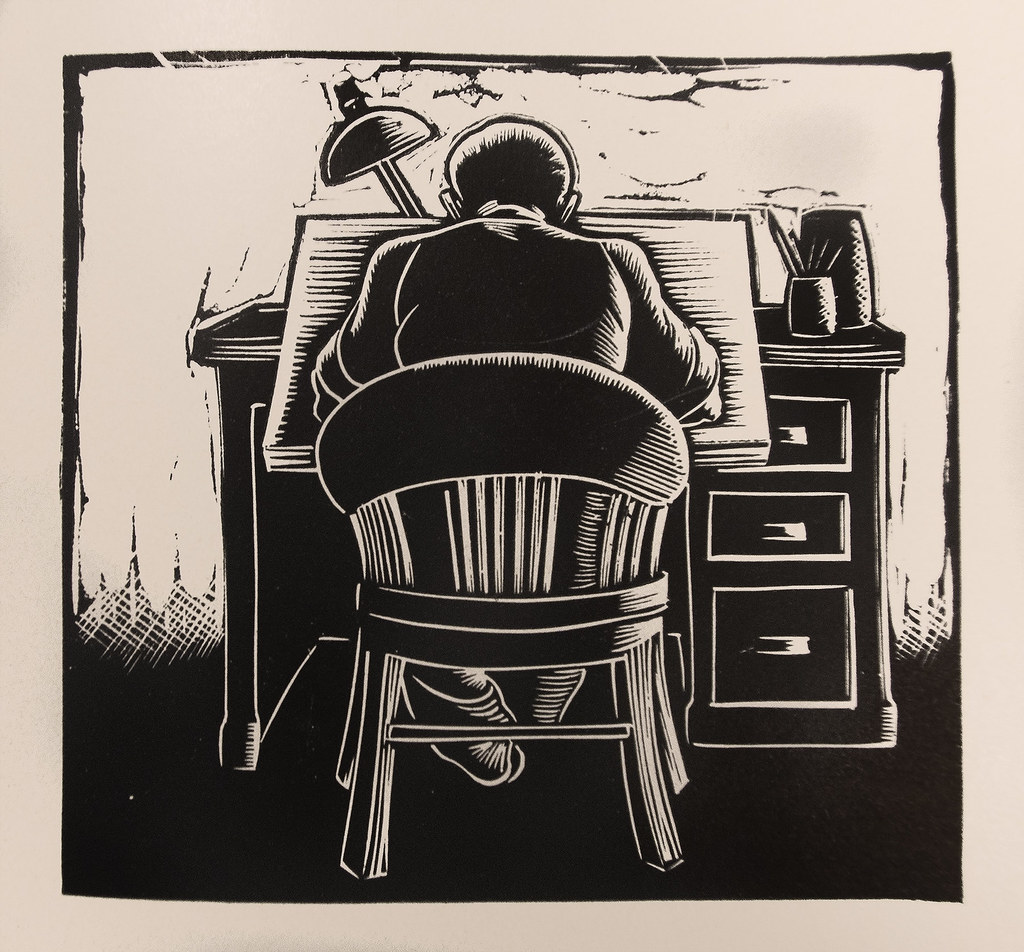
- Relief printing (woodcut, linocut): The artist carves away areas that will not print, leaving a raised surface that accepts ink and transfers it to paper. Woodcuts show the natural grain of the wood; linocuts tend toward cleaner lines and flatter areas of color. Both can be printed in black and white or run through multiple plates for color.
- Intaglio (etching, aquatint, drypoint): Lines are cut or bitten into a metal plate; ink fills those recesses, the surface is wiped clean, and damp paper is pressed in under high pressure. Look for a slight embossed rectangle at the print's edge - the plate mark where the metal pressed into the paper. Rembrandt worked in etching; Donald Sultan, the American printmaker whose work has appeared in Southwest Florida gallery programming, is known for large-scale aquatint etchings alongside lithographs and linocuts.
- Lithography: Based on the repulsion of oil and water rather than physical incision. The artist draws on a flat stone or aluminum plate with a greasy medium; the surface is chemically treated so drawn areas accept ink and blank areas repel it. Lithographs have a softer, more painterly quality than relief or intaglio. Regional artists have submitted lithograph entries to the Alliance for the Arts juried exhibit.
- Serigraphy (screen printing): Ink is pushed through a fine mesh screen; blocked areas stop the ink, open areas let it through. The process produces vivid, flat color and is closely associated with Pop Art - Andy Warhol's serigraphs are among the works available at HW Gallery in Naples.
- Monotype: The printmaker paints or draws directly onto a smooth, non-absorbent plate and transfers the image to paper in a single impression. Because nothing is permanently incised, the image cannot be exactly repeated - a monotype is technically an edition of one, occasionally two with a faint ghost print from residual ink. Each monotype is simultaneously a print and a unique work. Barbara Yeomans, who took Second Place in the Alliance for the Arts printmaking juried exhibit, works in monotype; Kathleen Moore teaches monoprinting with botanicals at the Naples Art District.
Institutional Collections: Where to See Historically Significant Prints
The Baker Museum at Artis-Naples holds a permanent collection with works on paper from multiple printmaking traditions. A dedicated exhibition mounted in the Hayes Hall Galleries in 2013 and into 2014 drew from that holding - Rembrandt etchings, 1938 Kandinsky prints, and works by Matisse, Braque, Rauschenberg, Cassatt, Léger, and Calder. That show didn't travel from elsewhere; it surfaced what Artis-Naples already owns. For a collector who wants to understand what an intaglio by Cassatt looks like beside a lithograph by Léger, the Baker Museum is the regional institution to follow for works-on-paper programming.
HW Gallery in Naples carries documented original prints by Picasso, Rauschenberg, Frank Stella, Warhol, Roy Lichtenstein, Jim Dine, Joan Miró, Marc Chagall, Alex Katz, Alexander Calder, and Marcus Jansen. This is a commercial gallery where authenticated prints by 20th-century masters are available to buy - one of the few places in Southwest Florida where a collector can stand in front of a Warhol serigraph and a Rauschenberg lithograph at the same time. Check their current address and inventory directly before visiting.
The Working Local Scene
The Alliance for the Arts in Fort Myers has hosted a dedicated printmaking juried exhibit - more than 60 artists, more than 140 pieces across monotype, etching, woodcut, linocut, and lithograph. Best in Show went to Juergen Strunck for "TTR-5." Second Place went to Barbara Yeomans for "Red Dot." Fort Myers printmakers Andy Browne, Daniel Venditti, and Susanna Wingenroth have also competed in the exhibit - a group worth tracking as their work moves through regional venues. No other recurring event in the region gives printmaking this kind of dedicated curatorial attention.
In Collier County, the Naples Art District counts printmakers among its more than 100 working resident artists. Kathleen Moore has taught "Monoprinting with Botanicals" as part of the district's class roster - one of the few named printmaking short courses available in the county, connecting the process to Southwest Florida's botanical landscape in a way that feels specific to this place. The SW Florida Fine Craft Guild's Excellence in Printmaking Award adds another recognition point for working regional printmakers, treating the medium as a discipline in its own right.
FGCU as the Regional Training Ground
Florida Gulf Coast University in Fort Myers runs the academic infrastructure most directly responsible for producing new Southwest Florida printmakers. The three-course sequence moves students from foundational technique to professional practice:
- ART 3443 Relief Printmaking covers woodcut and linocut in both black-and-white and multiple-plate color - the entry point for raised-surface processes.
- ART 3463 Alternative Printmaking expands into monoprint, collagraph (a print from a collaged plate surface), and acid-free processes - the course most directly connected to contemporary experimental work.
- ART 4923 Printmaking Workshop is the advanced critique-centered studio, focused on conceptual development and professional preparation. Students at this level are asking how printmaking functions in a current art context, not just how to pull a clean impression.
All three courses use non-toxic, acid-free materials throughout - a deliberate commitment that reflects where professional printmaking has moved over the past two decades, away from hazardous acids and solvents toward processes usable in shared studio spaces without industrial ventilation. FGCU also holds an Annual Juried Student Art Exhibition open to printmaking alongside painting, sculpture, drawing, and ceramics. Visiting this show is one of the most reliable ways to spot emerging regional printmakers before they enter the broader gallery scene.
Where to Take a Class
Three venues offer structured printmaking instruction to adults in the region, and they serve meaningfully different needs.
The Cape Coral Art Center has operated continuously since 1977, making it one of the region's oldest public art teaching facilities. It offers Relief Printmaking among its year-round classes for both adults and children, with no membership required to enroll. For a beginner seeking a low-commitment introduction to woodcut or linocut on the Lee County side of the region, this is the most accessible starting point. Check the city's arts programs page for current schedules.
The Naples Art Institute on Park Street in Naples runs one- and two-day adult printmaking workshops throughout the year alongside multi-week sessions in other media. The short format suits seasonal residents or visitors who want concentrated instruction rather than an ongoing commitment. Workshop dates shift seasonally; check the Institute's website directly.
The Naples Art District's workshops, including Kathleen Moore's "Monoprinting with Botanicals," require no prior printmaking experience and produce finished work in a single session - the most hands-on introduction to the monotype process currently available in Collier County. Class availability varies by season; the District's website lists the current roster.
Buying and Caring for Prints in the Florida Climate
Reading the Edition
Original fine art prints are signed in pencil - never pen - and numbered as a fraction. "7/25" means the seventh impression from an edition of 25. When the edition is complete, the matrix is customarily cancelled - the woodblock scored, the copper plate gouged - so no further prints can be made. A cancelled matrix is evidence of edition integrity; ask whether the edition is complete and whether the cancellation has been documented.
A sound certificate of authenticity for an original print should state:
- The artist's full name
- The title of the work
- The specific technique (etching, linocut, lithograph, and so on)
- The edition size and the specific impression number
- Year of execution or publication
- Whether the matrix has been cancelled
Certificates that omit the technique or edition size are a warning sign. Vague language like "original artwork" without specifying the process warrants a direct question before any purchase.
The Florida Conservation Challenge
Works on paper face specific threats here that don't apply with the same intensity in drier climates. Paper is hygroscopic - it absorbs and releases moisture from the surrounding air as humidity shifts. Conservation standards for works on paper call for a narrow, stable band of relative humidity; Southwest Florida's subtropical climate regularly pushes above that range, making active climate control essential rather than optional for serious collectors.
Framing decisions matter more in Southwest Florida than in almost any other part of the country. Follow this sequence when preparing a print for display in a Florida home:
- Choose museum-grade UV-filtering glazing. It blocks nearly all harmful ultraviolet rays - far more than standard window glass, which blocks only a small fraction. Year-round subtropical sunlight fades unprotected works on paper faster than most collectors expect.
- Use a window mat cut from acid-free archival board, not standard mat board, which is acidic and will gradually stain the paper at the edges.
- Mount the print with archival hinges or a sink mat rather than any adhesive. Adhesive mounting is permanent and irreversible; it destroys the print's condition rating and its resale value.
- Seal the back of the frame with acid-free tape or a rigid backing board to reduce moisture and dust infiltration from behind.
- Hang the framed work away from exterior walls (which can condense moisture in air-conditioned rooms) and away from direct airflow from vents.
Collectors near the coast face a further consideration: salt air accelerates oxidation on metal frames and hardware. Inspect frames annually; corrosion that reaches the mat or the paper backing causes damage that cannot be reversed.
Prints as a Collecting Category
For collectors, the question is not whether prints are as prestigious as paintings. It is whether the fixed supply and the lower entry price represent a structural advantage that paintings, by their nature, cannot offer.
Original prints by living Southwest Florida artists typically sit below the price of the same artist's paintings, partly because prints exist in editions and partly because the regional market hasn't fully caught up to the medium's collecting tradition. That gap is an opening worth taking seriously. A numbered linocut or etching by a Fort Myers artist competing at the Alliance for the Arts level is not a budget substitute for painting - it is a work with a fixed population of impressions that can only redistribute, never grow.
A Warhol serigraph from an edition of 250 will always be from an edition of 250. That ceiling is permanent once the matrix is cancelled, and it applies equally to a linocut from a regional artist showing at the Alliance for the Arts. The difference is timing. Artists appearing now at the FGCU Annual Juried Student Art Exhibition or the Alliance juried exhibit are building careers that will move through the regional gallery market. Buying early in a closed edition, while an artist is still at the juried-show stage, is a different strategy from the secondary market - and one the Southwest Florida scene currently supports. Following named artists from those shows and tracking their work as it moves into galleries is how a regional print collection gets built with both focus and advantage.
Frequently Asked Questions
Where can I see and buy work by living Southwest Florida printmakers?
The Alliance for the Arts juried printmaking exhibit in Fort Myers is the most concentrated single event in the region, drawing artists working in monotype, etching, woodcut, linocut, and lithograph. Artists from recent shows - including Barbara Yeomans, Andy Browne, Daniel Venditti, and Susanna Wingenroth - are worth following as their work moves through regional venues. The Naples Art District counts printmakers among its more than 100 resident working artists and is another venue where regional printmakers show and sell work. For authenticated prints by major 20th-century artists, HW Gallery in Naples carries inventory that includes works by Warhol, Picasso, Miró, and others; check their current address and holdings directly before visiting.
How does edition size affect what I should pay for a print?
A smaller edition means structural scarcity. An impression from an edition of ten will always be rarer than one from an edition of 250, and prices for living artists' work typically reflect that difference. For historical prints by major artists, edition size is part of the documented record and is factored into market pricing alongside provenance and condition. Within any single edition, impression numbers carry no quality distinction - each was pulled from the same matrix under the same conditions. What matters for long-term value is that the edition is genuinely closed and the matrix cancelled, which fixes the supply permanently and is why asking about cancellation before buying is a standard step rather than an unusual demand.
Are the FGCU printmaking courses open to adults who aren't degree students?
The three-course sequence at FGCU is part of the university's degree program and is not typically open for general adult enrollment. Adults seeking structured printmaking instruction without a degree program have better options at the Cape Coral Art Center's year-round classes, the Naples Art Institute's one- and two-day workshops, or the Naples Art District's short courses. Contact each venue directly for current availability and enrollment requirements.
Is a monotype considered a print or a unique work?
It is both, which puts it in an unusual position for collectors. The process uses a physical plate, ink transfer under pressure, and paper - all the mechanics of printmaking - but because nothing is permanently incised into the matrix, the image cannot be exactly repeated. A monotype is typically an edition of one, occasionally two if a faint ghost impression is pulled from residual ink. That means it carries the process history of printmaking but the supply structure of a painting: there is no numbered edition to close, and no additional impressions can ever come to market. Collectors who follow print-market logic around edition scarcity should price and consider monotypes differently from numbered etchings or linocuts. Barbara Yeomans, whose monotype work placed Second at the Alliance for the Arts juried exhibit, is one regional printmaker working at the intersection of those categories.